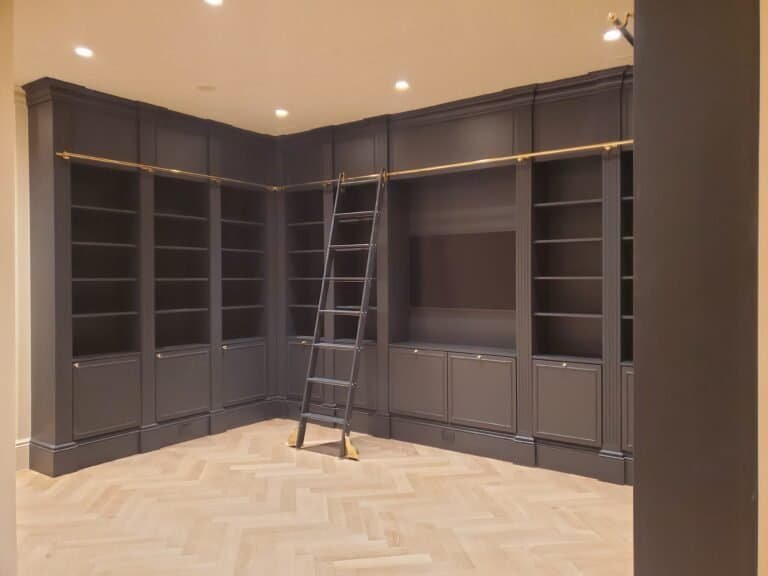
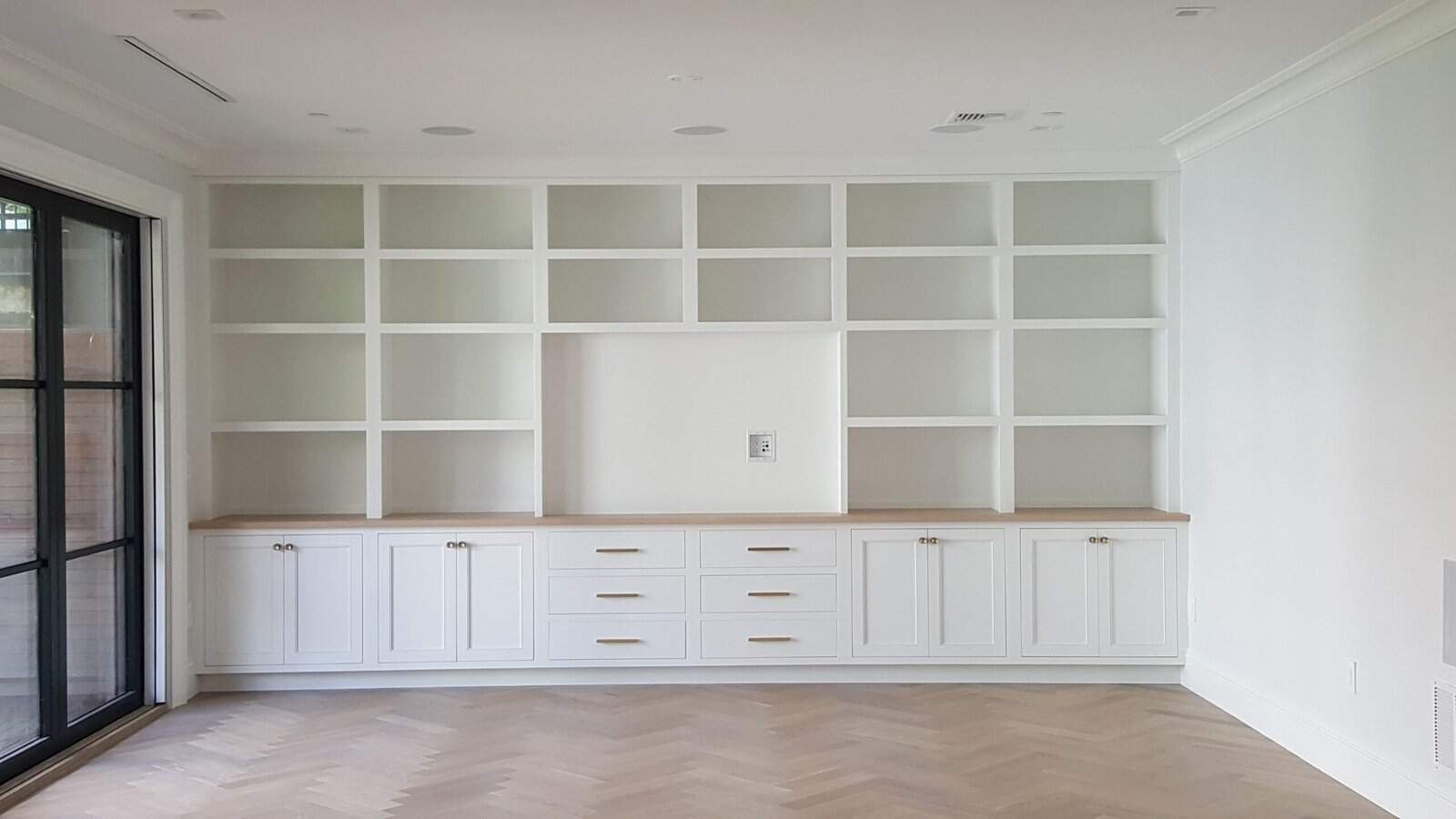
A full wall of built-in shelving does something to a room that no freestanding furniture can replicate. It makes the room feel intentional. The space stops being a room with furniture in it and starts being a room that was designed. That shift in feeling is hard to explain until you see it, and the photo above shows exactly what we mean.
This project is a full-wall built-in we completed for a homeowner in Lancaster County, Pennsylvania. Painted white with brushed brass hardware, open shelving across the full width and height of the wall above, lower cabinets with shaker doors and a run of drawers in the center section, and a warm wood countertop that separates the two zones. The room has herringbone white oak floors and steel-frame glass doors to the exterior, which set the tone for the whole design.
If you have a wall in your home that is not doing anything useful, or a living room, office, or den that needs a focal point, a custom built-in bookcase is one of the highest-impact changes you can make to a room. This post covers how to think about the design, what the options are, and what goes into building one properly.
What Separates a Good Built-In from a Great One
The difference is usually in the transitions. A great built-in does not look like a piece of furniture placed against a wall. It looks like it grew there. The crown molding meets the ceiling cleanly. The base molding continues the existing baseboard profile. The sides of the unit are flush with the walls or cased in a way that reads as architectural rather than applied.
Getting those transitions right requires two things: accurate measurement of the actual space, and the ability to scribe, cut, and fit on-site. A factory-built unit shipped flat and assembled on location almost never achieves this, because real rooms have out-of-plumb walls, uneven ceilings, and floors that are not perfectly level. Our craftsmen measure the actual space, build the cabinetry to fit it precisely, and handle all the scribing and trimwork during installation.
The project above is a good example. The unit runs the full width of the wall with no filler strips at the sides. The crown molding at the top follows the ceiling line, which in this room was level enough for a clean horizontal run. The base sits flush with the existing baseboard. None of that happens by accident.
How This Design Works: Upper Shelving and Lower Cabinets
The most functional layout for a built-in wall unit separates it into two distinct zones. The lower zone, roughly desk height or counter height, is closed storage: cabinet doors and drawers for items you use but do not need to display. The upper zone is open shelving for books, objects, art, and whatever you want visible.
In this project the lower zone uses shaker-style cabinet doors on either side with a center section of four drawers. The wood countertop across the full width of the lower section creates a clean horizontal line that visually anchors the whole piece and provides a surface for lamps, objects, and everyday use.
The upper zone has three rows of open shelving with varying bay widths. The center section is wider to allow for larger objects or artwork, and the center middle section is left open at cabinet height to accommodate a TV or display piece backed by the wall. The electrical outlet visible in the photo confirms this was planned during construction, not retrofitted.
This is an important point: electrical rough-in during construction is far cleaner than retrofitting after the fact. If your built-in will have a TV, under-cabinet lighting, or device charging, those needs should be identified before the unit goes in, not after. We coordinate with your electrician during the planning phase as a standard part of our process.
Why White Works for Built-Ins in Pennsylvania Homes
White painted built-ins are consistently the most requested finish in this category, and there are good practical reasons for it beyond aesthetics.
A white built-in reads as architectural rather than as furniture. It recedes slightly and lets the contents of the shelves and the objects in the room become the visual focus. A stained wood built-in, by contrast, is more of a statement piece that competes for attention with everything else in the room. Neither is wrong, but for a living room or home office where the goal is a backdrop for living rather than a centerpiece, white tends to work better.
White also works across a much wider range of interior styles than any stained finish. The unit in this photo would look at home in a contemporary house, a traditional colonial, a farmhouse renovation, or a beach house. Stained oak would narrow those options considerably.
We apply painted finishes in our Honey Brook finishing department using a conversion varnish topcoat rather than standard latex paint. The result is harder, more cleanly sprayed, and far more resistant to scuffs and fingerprints than anything brushed on site. You can learn more about our finishing process on our construction and craftsmanship page.
Hardware: Small Detail, Big Effect
The hardware on this unit is brushed brass, and it earns its place. On a white built-in, hardware is one of the few opportunities to add warmth and a point of visual interest. Brushed brass does that without drawing too much attention. It is a quiet upgrade that the room registers without announcing itself.
Other hardware directions that work well on white built-ins:
- Matte black for a sharper, more contemporary look. Very clean against white, particularly in rooms with black window frames or dark accents, as in this project where the steel-frame glass doors introduce black as an element.
- Brushed nickel for the most neutral, versatile choice that matches virtually any other metal in the room.
- Oil-rubbed bronze for a warmer, more traditional feeling in homes with that aesthetic.
We can lay hardware samples against painted cabinet samples at our showroom before you make a final decision. It takes ten minutes and consistently changes people’s minds from their original choice.
Where Customers in Lancaster County Are Putting Built-In Bookcases
The obvious location is the living room or family room, but we build custom built-ins across many different rooms, and each application has slightly different design requirements.
Home offices are the fastest-growing category right now. A full-wall built-in behind a desk makes a home office feel serious and functional rather than improvised. The storage capacity is significant, the appearance on video calls is professional, and the organization it provides makes the room genuinely easier to work in. For more on this see our custom cabinetry services.
Dining rooms in older Lancaster County homes often have a blank wall that was originally meant for a china cabinet or hutch. A built-in with glass-front upper cabinets and closed lower storage serves the same purpose with a fraction of the visual mass and much more storage capacity.
Basements and finished lower levels benefit enormously from built-in shelving because the rooms tend to be used for multiple purposes and need flexible storage. A built-in along one wall creates structure in what would otherwise feel like a temporary space.
Bedroom alcoves in Victorian and colonial homes throughout Lancaster, Lititz, Elizabethtown, and Ephrata often have awkward recesses that are difficult to furnish conventionally. A custom built-in that fills the alcove exactly turns an architectural inconvenience into a useful feature.
How We Build a Built-In Bookcase: From Measurement to Installation
The process starts with a site visit or detailed measurements from the homeowner. We need to know the wall dimensions, ceiling height, any obstacles like outlets, HVAC vents, or light switches, and whether there are any architectural features like crown molding, chair rail, or baseboards that the new unit needs to coordinate with.
From there we produce a design drawing that shows the exact layout: bay widths, shelf heights, drawer dimensions, and how the unit terminates at the sides, floor, and ceiling. Once the design is approved, production takes place in our 20,000 sq ft facility in Honey Brook, PA. The unit is built in sections, finished in our spray booth, and delivered in manageable pieces for installation.
Installation typically takes one to two days for a full-wall unit like the one shown above. Our crew handles scribing, fitting, fastening, and any touch-up work needed after the unit is in place. We do not hand you a pile of panels and leave. You can read more about how each stage works on our how we work page.
For inspiration on how built-in shelving is being used in homes nationally right now, Architectural Digest has an excellent collection of built-in library and bookcase designs across a wide range of styles and budgets.
Related Projects to Explore
Built-in bookcases share design DNA with several other project types we build regularly. If you are thinking about a library wall in the living room, you might also find these useful:
- Custom built-in entertainment centers for rooms where a TV is the focal point rather than books and objects
- Our guide to floor-to-ceiling cabinetry, which covers the scribing and crown molding work that makes any full-height installation look right
- The traditional family room project in Philadelphia, which shows a different approach to a similar wall-unit concept
Questions About Built-In Bookcases
How much does a custom built-in bookcase cost?
A single-bay floor-to-ceiling built-in starts around $2,500 to $4,000 installed. A full-wall unit like the one shown here, spanning 12 to 16 feet with lower cabinets, a countertop section, and full-height open shelving, typically ranges from $8,000 to $18,000 depending on width, finish, hardware, and complexity. Request a quote with your wall dimensions for a specific number.
How long does a built-in bookcase project take?
From consultation to completed installation, most built-in projects take 8 to 10 weeks. That includes design, production in our Honey Brook shop, finishing, and installation. Simpler single-bay units can sometimes move faster. Larger or more complex installations with multiple rooms take longer.
Can you match the built-in to existing trim and molding in the house?
Yes, matching existing profiles is one of the things we do routinely. We will need a sample of your existing baseboard and crown molding, or detailed measurements and photos, to replicate the profile. In older homes in Lancaster, Chester County, and the Philadelphia area where historic trim profiles are no longer commercially available, we can mill custom matching profiles in our shop.
Do you need to open the wall for a built-in bookcase?
Not usually. A surface-mounted built-in is fastened to the wall framing and sits in front of the drywall. Wall opening is only needed if you are adding electrical inside the unit, moving a vent, or recessing the unit into the wall cavity for additional depth. We assess this during the site visit and tell you exactly what is required before any work starts.
Do you serve the Philadelphia suburbs and Main Line for built-in projects?
Yes. We regularly build and install custom built-ins across Chester County, Montgomery County, Delaware County, and the Philadelphia Main Line, in addition to our home base in Lancaster County. Call us at (610) 273-2907 or request a quote online to start the conversation.
Ready to Build Your Bookcase?
If you have a wall in mind and want to see what a custom built-in could look like in your specific space, the first step is a conversation. We offer free consultations at our 6,000 sq ft showroom in Honey Brook and can visit your home for larger projects.
We work with homeowners throughout Lancaster County, Chester County, Berks County, York, and the greater Philadelphia area. Request a free quote online or call (610) 273-2907. And if you want to see more of what we build before you visit, our project gallery covers kitchens, living rooms, bathrooms, and everything in between.