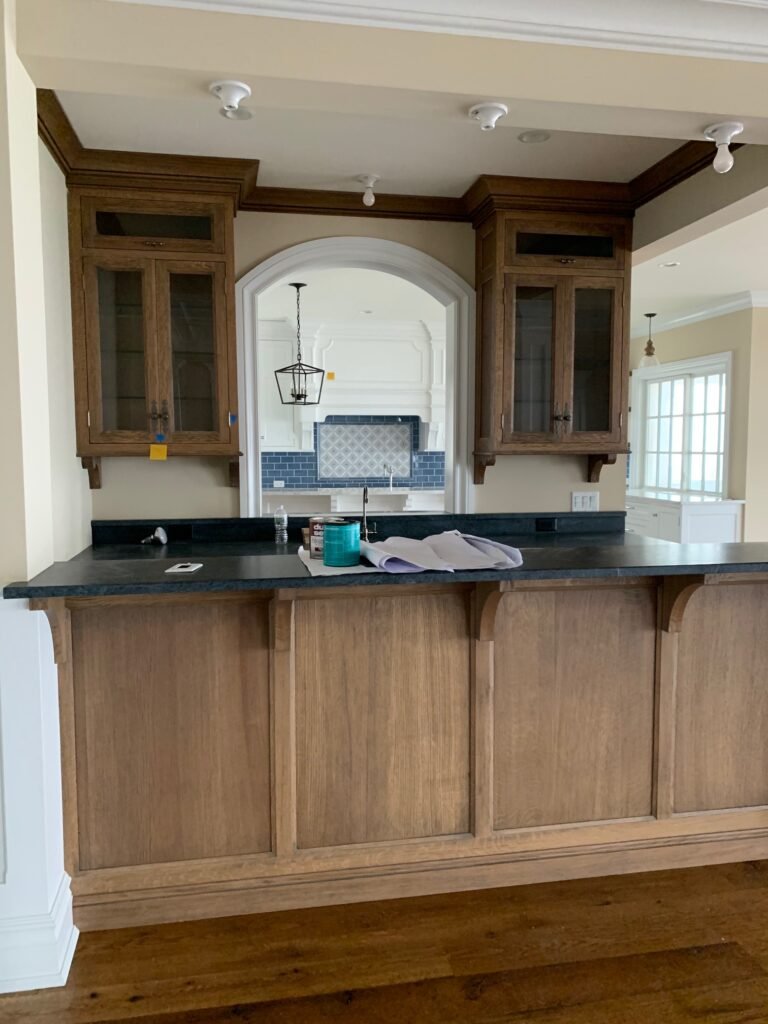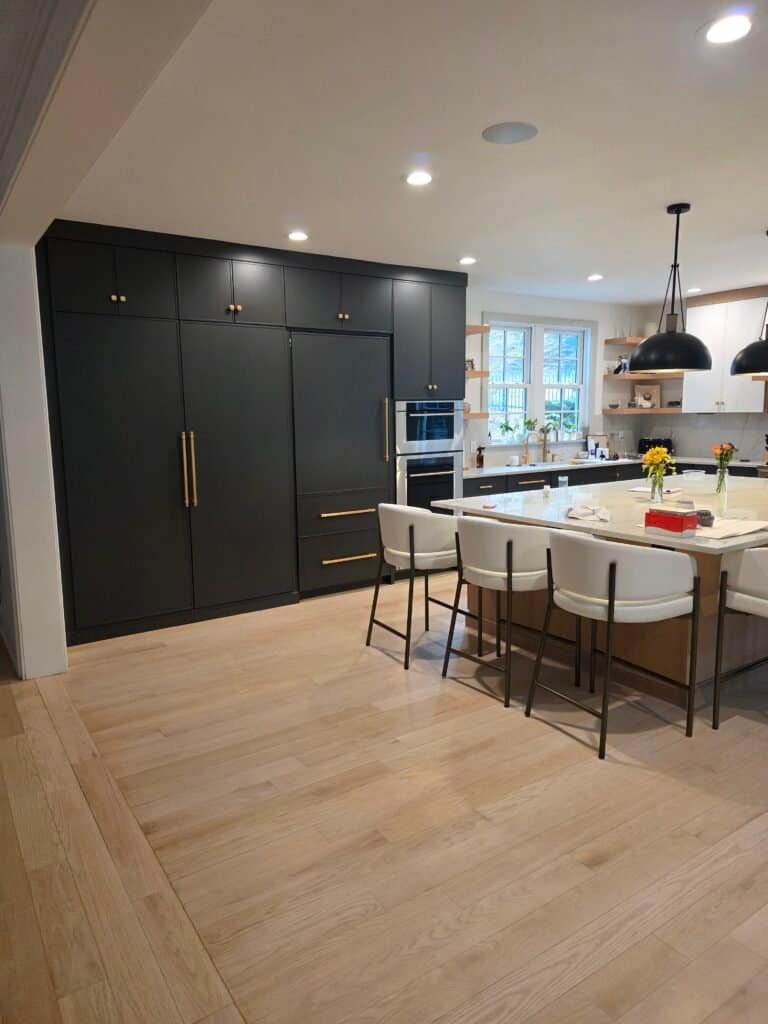
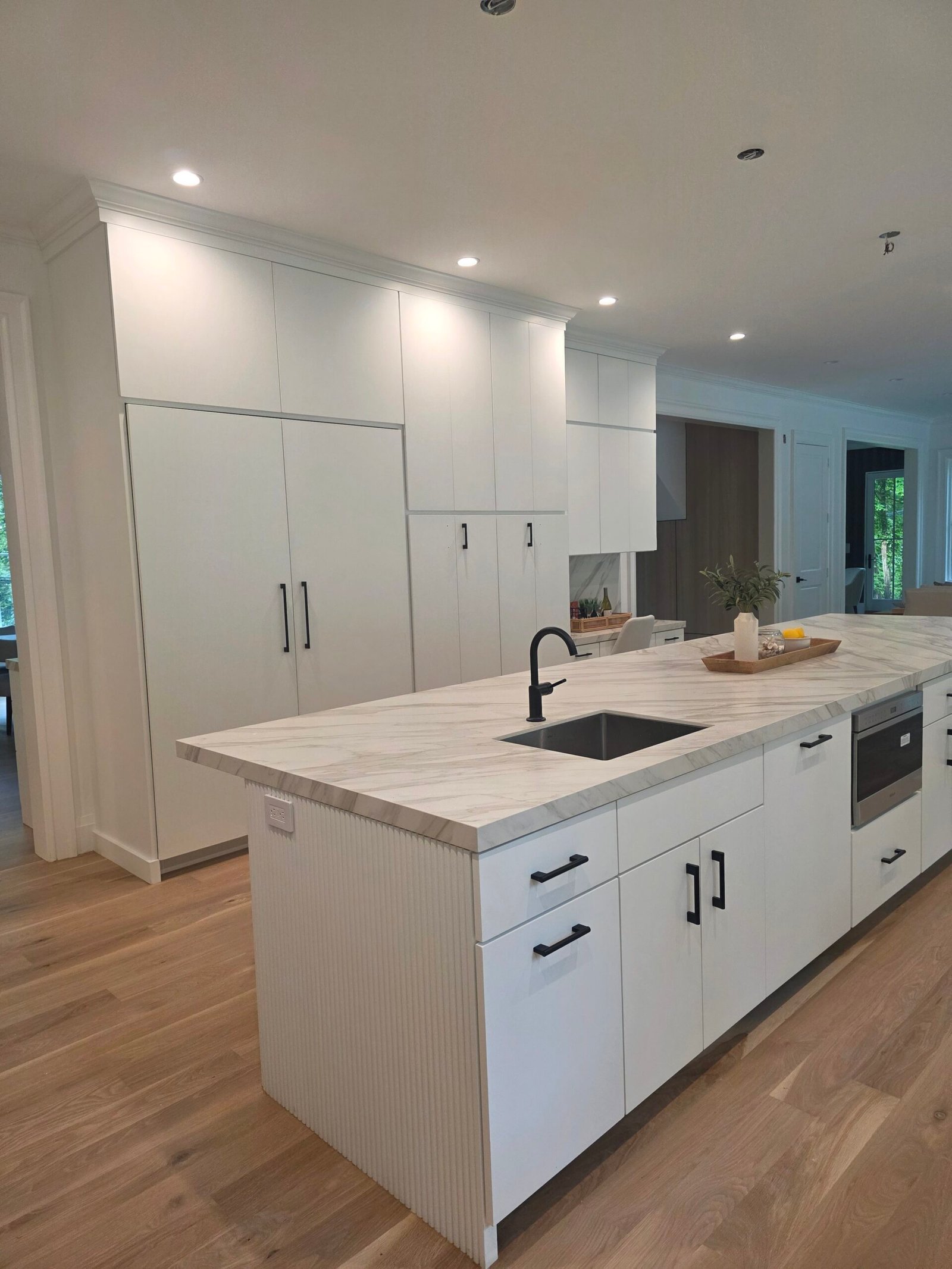
Most kitchens waste a lot of space. Not on the counters, not in the drawers, but up high. That gap between the top of your cabinets and the ceiling is usually filled with dust, a few forgotten cake pans, and good intentions. In a lot of Pennsylvania homes we visit, that gap is eight inches, sometimes a foot, sometimes more.
Running your cabinets all the way to the ceiling solves that. It gives you back usable storage, it makes the room feel taller, and when done right it looks intentional rather than just tall. But there are a few things that trip people up when they try to do it, and that is what this guide is for.
We have been building custom cabinetry out of Honey Brook, Pennsylvania since 1979. In that time we have seen every ceiling height, every out-of-level situation, and every door style question you can imagine. Here is what we have learned.
Your Ceiling Is Not Level. That Is Normal.
The first thing homeowners are surprised by is this: your ceiling height is almost certainly not the same across the entire wall. Foundations settle over time. Drywall has small waves. In older homes in Lancaster County and Chester County, a ceiling that measures 108 inches in one corner might be 107 or 107.5 inches just a few feet away.
When you order standard tall cabinets from a big-box store and push them against a wavy ceiling, you get a visible dark gap along the top edge. It looks unfinished. Some people try to caulk it, which works briefly and then cracks.
The proper solution involves two things: scribing and a two-piece crown system. Neither of these is complicated once you understand what each piece does.
What scribing means
Scribing is the process of cutting a piece of wood to follow the exact contour of your ceiling. Think of it like tracing the wave of the ceiling onto a flat board, then cutting along that line. When that piece is installed on top of the cabinet, it touches the ceiling at every point with no gap and no caulk. Our craftsmen do this by hand on every floor-to-ceiling installation we complete in Pennsylvania.
How the two-piece crown system works
On top of the scribed piece, which is sometimes called a frieze board or riser, we add the decorative crown molding. The crown is not structural. Its job is to create a clean, finished visual line between the cabinet and the ceiling. The riser handles the imperfect ceiling. The crown handles the appearance.
If you want to go deeper on crown molding profiles, proportions, and wood species options, we have a full post on custom crown molding engineering and specs that covers the details.
Full Custom or Semi-Custom: Which One Makes Sense for Your Ceiling?
We build two types of cabinetry, and they approach tall installations differently. Neither is better in every situation. The right choice depends on your ceiling height, your budget, and what the room needs to do.
Full custom: built to your exact dimensions
With our full custom line, we build the cabinet box to whatever height your space requires. If your ceiling is 103.5 inches, we build the cabinet to precisely that minus the molding allowance. No filler pieces, no visible joints halfway up the door. Just one continuous run from floor to ceiling.
This approach works especially well in homes with non-standard ceiling heights, which is common in older houses throughout Philadelphia, Reading, and Harrisburg. It also works well for modern kitchens where a seamless, panel-to-ceiling look is the goal.
Wood species options for full custom are wide open. We work with maple, cherry, white oak, rift-sawn oak, walnut, hickory, and painted finishes in any Sherwin-Williams color. You can see examples across different wood types and finishes in our project gallery.
Semi-custom: the stacked approach
Our semi-custom cabinets use a stacking method. Standard-height upper cabinets sit on the wall, and shorter stacker cabinets sit on top of them to fill the space to the ceiling. The two pieces are finished in the same color, which makes the seam nearly invisible once the crown goes on.
This approach costs less and builds faster. For most kitchens in the 8 to 9-foot ceiling range, it produces results that are nearly indistinguishable from full custom at a fraction of the price. If your goal is maximum storage and a clean finished look without a custom price tag, semi-custom stacking is worth a serious look.
Can You Have One Tall Door That Goes All the Way Up?
This is probably the question we get most often when someone is planning a floor-to-ceiling kitchen or pantry. The short answer is yes. The longer answer is that there are some practical considerations you should know about first.
Wood moves. It expands when the air is humid and contracts when it is dry. A standard 30-inch cabinet door has enough structural integrity to handle that movement without any issues. A door that is 84 inches tall is a different story. That much vertical height means more surface area reacting to every humidity change in your kitchen, and if the door is not engineered correctly, it will eventually warp or twist at the edges.
Here is how we handle it for doors in our custom door line:
- Engineered stiles and rails. For extra-tall doors, we use composite cores in the frame members that resist twisting. The face is still solid wood. The structure resists movement.
- Four or five hinges per door. A standard door uses two or three. Taller doors need more support points to stay tight across the full height. We upgrade the hinge spec automatically for any door over 48 inches.
- The stacked door option. For people who want maximum stability and do not mind a horizontal break, we often recommend splitting the run into a main door on the bottom and a smaller door on top. The visual break is subtle, especially with matching hardware, and the wood movement in each piece is much easier to control.
There is no single right answer here. It depends on your kitchen’s humidity levels, the wood species you choose, and the look you are after. We talk through all of this during the design process. You can learn more about how our design process works or come see door samples in person at our Honey Brook showroom.

High Cabinets Are Only Useful If You Can Actually Reach Them
A lot of homeowners add floor-to-ceiling cabinets and then never use the top third. The shelves are too high, the items get forgotten, and the space becomes the same dead zone it was before, just enclosed now.
The fix is thinking about what actually goes up there before the cabinets are built, not after.
Vertical dividers instead of shelves
The top section of a tall cabinet is actually ideal for things you store upright: baking sheets, cutting boards, cooling racks, serving platters, trays. A shelf is useless for these because you end up stacking them and then pulling out everything just to get to the one on the bottom. Vertical dividers let you slide individual items in and out without moving anything else. We can build these into the cabinet at any spacing you need.
The library ladder
For ceilings over nine feet, a rolling ladder rail integrated into the millwork is one of those additions that sounds like a luxury but actually gets used every day. The rail is recessed into the upper cabinet face frame so it looks like part of the design. The ladder rolls along it and stores flat against the wall when not in use. For clients in larger homes across Philadelphia and the Main Line, this has become one of the most requested features we add.
Glass doors and lighting in the upper section
Upper cabinets with glass doors and internal LED lighting do two things at once. They show off the items inside, which makes the space feel curated rather than cluttered. And they add ambient light to the upper part of the room in the evening, which most kitchens are short on. We can rough in the wiring during construction so the installation is clean with no visible cords.
For a look at how floor-to-ceiling cabinetry works in a living room context, see our custom built-in entertainment center project. The principles are the same: scribing to the ceiling, solid hardwood construction, and storage that is actually designed to be used.
Which Rooms Benefit Most from Floor-to-Ceiling Cabinetry
Kitchens are the most obvious application, but they are not the only one. We build floor-to-ceiling cabinetry throughout homes in Lancaster County, Chester County, York, and Harrisburg, and the rooms that tend to benefit most are the ones with the most storage demands and the least floor space to work with.
Kitchens are the primary use case. More vertical storage means more counter space stays clear. For reference, This Old House has a solid overview of kitchen cabinet planning fundamentals if you want a baseline before you start thinking about custom options.
Pantry rooms and butler’s pantries are where floor-to-ceiling really shines. A dedicated pantry with full-height cabinetry on three walls can hold more than most families will ever need, and it keeps the kitchen itself clear for food preparation.
Home offices benefit from the same logic. A wall of built-in cabinetry from floor to ceiling eliminates bookshelves, filing cabinets, and storage bins, and replaces them with one unified piece that looks like it belongs to the room. See our recent white kitchen project for how we think about integrating cabinetry into the architecture of a room.
Common Questions About Floor-to-Ceiling Cabinets
How much more do floor-to-ceiling cabinets cost compared to standard height?
For semi-custom stacked cabinets, the premium for going to the ceiling is usually modest, since you are adding stacker units on top of an existing cabinet run. Full custom tall cabinets cost more because every box is built to a specific dimension, but the price per linear foot is not dramatically different from standard-height custom work. The bigger variable is always the installation, since scribing and crown work takes more time than a straight cabinet drop. Request a quote with your room dimensions and we can give you real numbers.
What ceiling height works best for floor-to-ceiling cabinets?
Eight feet is the minimum where it makes visual sense. At 8 feet, you lose the floating gap above standard cabinets and gain a clean continuous line. Nine and ten-foot ceilings are ideal because the proportions naturally suit taller cabinetry. Above ten feet, the top section starts to feel out of reach for daily use, which is where the library ladder option becomes worth considering.
Do you handle the full installation or just deliver the cabinets?
We handle everything from design through final installation for customers across Pennsylvania. For customers outside our service area, we deliver and provide detailed installation documentation. Our team does the scribing, crown work, and all finish touches on-site. Nothing is left for you to figure out. You can read more about our process on the about page.
Can you match existing cabinets in my kitchen?
In most cases, yes. We can match door profiles, finish colors, and hardware to existing cabinetry if you are adding to a kitchen rather than replacing it entirely. Bring photos and any finish information you have to the consultation and we will tell you honestly whether a match is achievable. Visit our showroom in Honey Brook to see how different wood species and finishes look in person.

Thinking About Going to the Ceiling?
If you have been living with that gap above your cabinets and wondering whether it is worth fixing, the answer is almost always yes. The storage you gain is real, the visual improvement is immediate, and a well-built floor-to-ceiling installation adds lasting value to the home.
We work with homeowners throughout Lancaster, Chester County, Philadelphia, Reading, York, and Harrisburg. Consultations are free, and you can get started either by visiting our showroom or by requesting a quote online.
Not sure where to start? Our design team can walk you through the options for your specific ceiling height, room layout, and budget before you commit to anything.
Curious about materials? Read why we build every box from solid wood kitchen cabinets and what that means for longevity.
Budgeting a floor-to-ceiling wall? See our real numbers on what built-in bookcases cost in Pennsylvania.