If you are planning a kitchen renovation in Pennsylvania and trying to figure out what custom cabinets will actually cost, you have probably already found that the numbers online range from confusingly low to surprisingly high. National averages pulled from aggregator sites are not particularly useful when you are trying to budget a real project in a real house.
This guide gives you actual numbers based on projects we complete in Lancaster County, Chester County, Berks County, and the Philadelphia area. We are Choice Custom Cabinetry and Design, an Amish cabinet shop that has been building in Honey Brook, Pennsylvania since 1979. We are not going to give you a number so wide that it is meaningless. We are going to tell you what our projects actually cost and what makes that number move up or down.
The Actual Numbers: What Custom Kitchen Cabinets Cost in 2026
For a fully custom kitchen built by our shop in Pennsylvania, here is where projects typically land:
- Small kitchen under 150 square feet: $15,000 to $25,000 installed
- Medium kitchen 150 to 250 square feet: $25,000 to $45,000 installed
- Large or luxury kitchen: $45,000 to $80,000 and above
Per linear foot, fully custom kitchen cabinetry from our shop runs roughly $550 to $1,200 per linear foot installed, depending on wood species, door style, finish complexity, and layout. A standard 10×10 kitchen has approximately 20 linear feet of cabinetry. At the midpoint of that range, a 20-linear-foot kitchen comes out around $17,000 to $18,000 installed.
Those are installed prices. They include design, materials, production, finishing in our Honey Brook shop, delivery, and installation by our own crew. What they do not include is countertops, appliances, plumbing, electrical, or flooring. Our full pricing guide has a room-by-room breakdown if you want to see what other project types cost.
Why National Averages Do Not Tell You Much
You will see figures like “$500 to $1,500 per linear foot” cited across the internet, and that range is technically accurate at a national level. But it is almost useless for planning a specific project because it blends the cost of a basic painted maple kitchen in rural Ohio with the cost of a full inset white oak kitchen on the Philadelphia Main Line into one number.
What actually determines your number is a combination of where you are, who builds the cabinets, what materials you choose, how complex the layout is, and whether the installer is the same company that built the cabinets or a separate contractor. In the Pennsylvania market, costs sit toward the middle of the national range. We are not New York City, but we are not rural Midwest either.
The most reliable way to get a number for your specific project is a design consultation with a local cabinet maker who can measure your space, understand what you want, and give you a real quote. We offer that at no charge with no obligation. More on that at the end of this post.
What Makes the Price Go Up or Down
Understanding the variables that drive cabinet cost lets you make intentional choices rather than being surprised by the final number. Here is what moves the needle most.
Wood species
This is the single biggest cost variable in custom cabinetry. Paint-grade poplar or soft maple, which is what most painted kitchens use, is the most economical choice. The wood disappears under paint so the species matters less than the smoothness of the substrate. Cherry, hickory, and hard maple sit in the middle of the range. White oak and walnut, which are the most requested species in Pennsylvania kitchens right now, sit at the top.
To give you a sense of the range: a 30-linear-foot kitchen in painted poplar will cost meaningfully less than the same 30-linear-foot kitchen in rift-cut white oak with a natural finish, even if every other variable is identical. The species premium on a full kitchen can be $4,000 to $10,000 or more depending on the size of the project.
If white oak is on your list, our post on white oak kitchen cabinets in Pennsylvania covers the material in detail, including the difference between rift-cut and quarter-sawn and how they affect both appearance and cost.
Door construction: overlay, inset, raised panel
Full overlay doors, where the door covers the face frame, are the standard in most modern kitchens and are the most economical door construction. Shaker-style full overlay doors are particularly efficient to produce and represent solid value.
Inset doors, which sit flush within the face frame opening rather than covering it, add roughly 15 to 25 percent to the door component of the cost. They require tighter tolerances, more adjustment time during installation, and more precise construction throughout. The result looks exceptional — the cabinets read as furniture rather than cabinetry — but the premium is real.
Raised panel doors cost more than shaker or flat slab doors because of the additional machining and setup time involved. The cost difference is meaningful but not dramatic on a full kitchen.
Browse our full door style selection to see what the options look like before your consultation.
Kitchen size and layout complexity
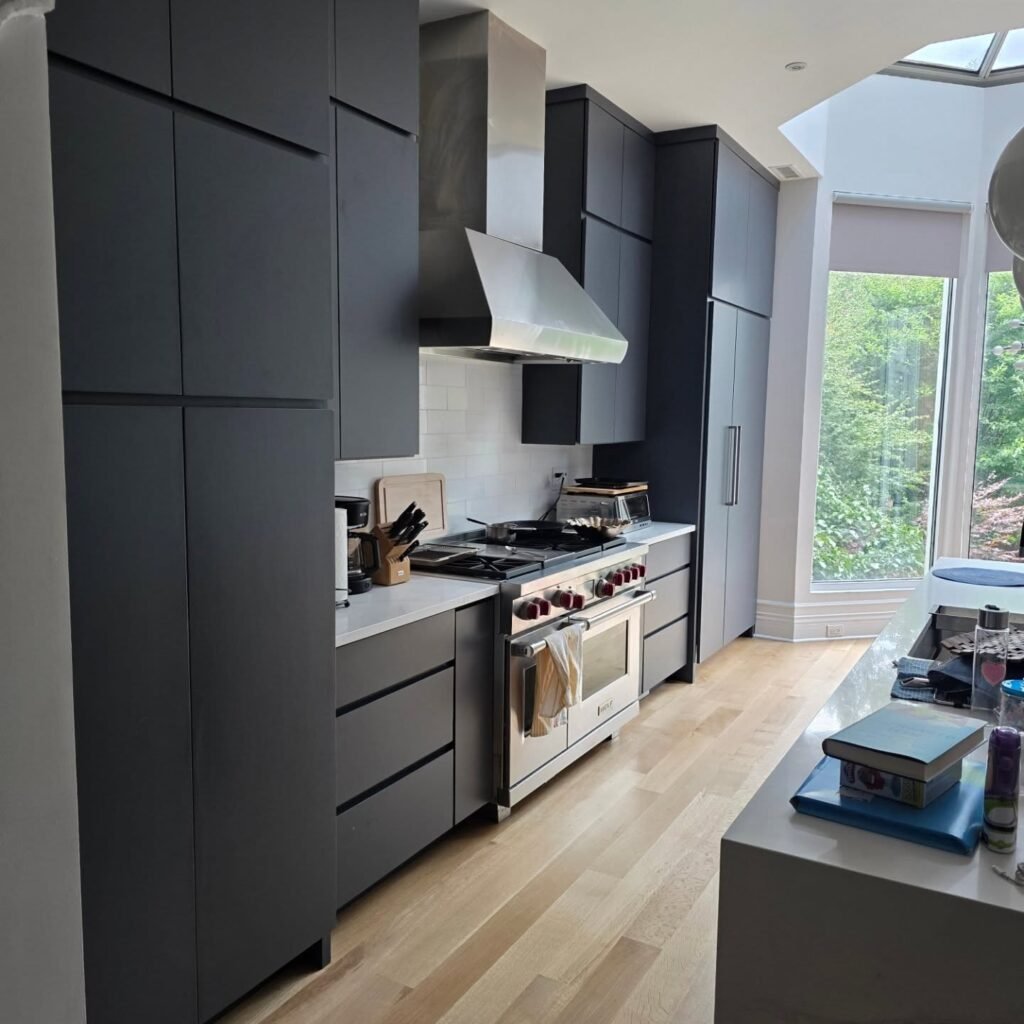
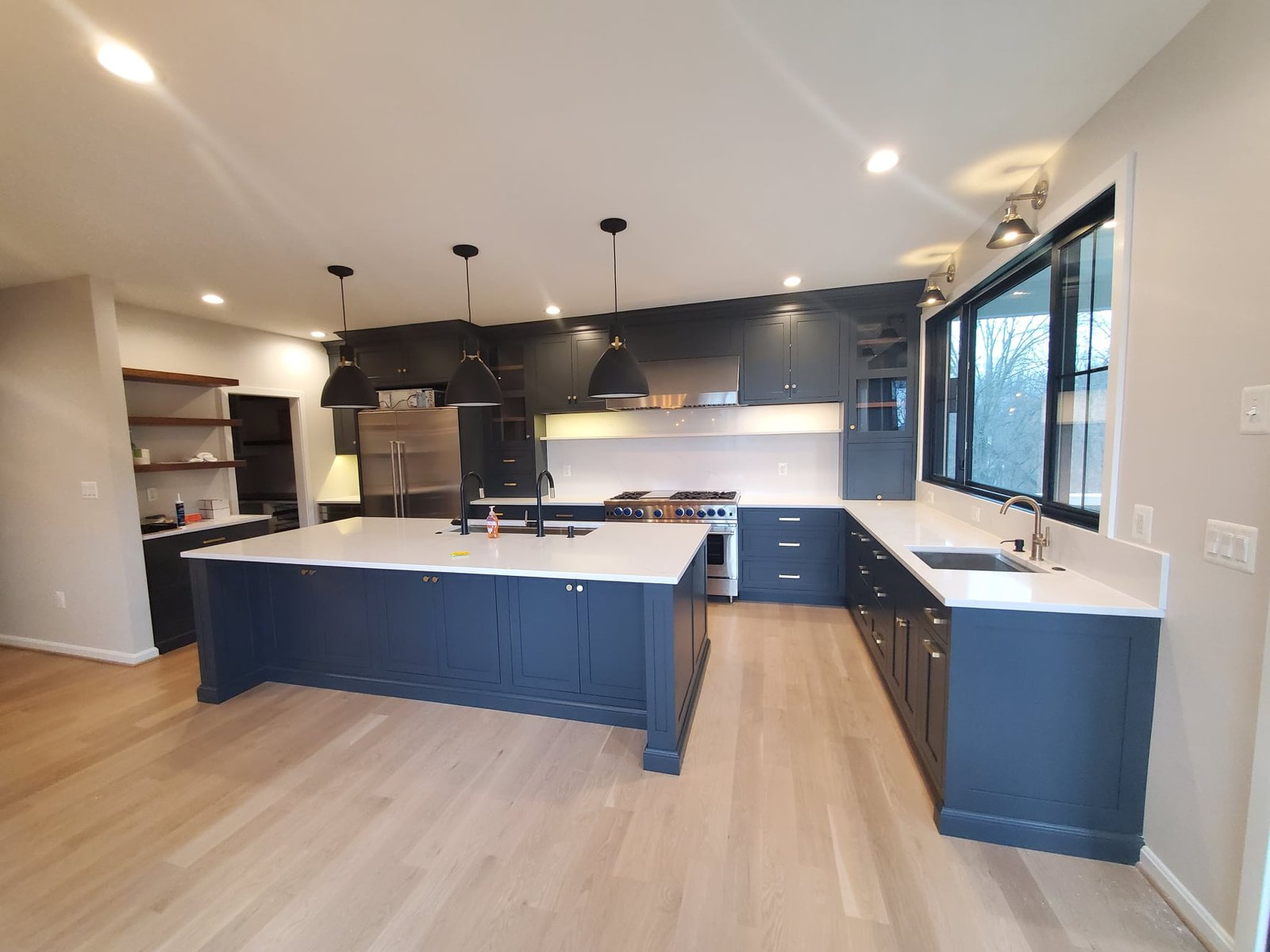
A simple galley kitchen with one long run on each wall and no island is less expensive to build and install than an L-shaped kitchen with an island, a tall pantry column, and two blind corners. Each specialty cabinet, whether it is a pull-out trash unit, a blind corner solution, a lazy susan, or an appliance garage, adds both material and labor cost.
Ceiling height is a factor too. Standard upper cabinets top out around 84 inches. If you want to take cabinets all the way to a 9 or 10-foot ceiling, you need either separate stacker units on top or full custom tall uppers. Both add cost, and both are worth it visually. Our guide to floor-to-ceiling cabinetry covers this in detail.
Finish type and complexity
A standard painted or stained finish applied in our Honey Brook finishing department is included in the base price. Specialty finishes, including glazed, cerused, wire-brushed, or multi-step decorative finishes, add production time and cost. Painted finishes require more surface preparation and coats than stained finishes to achieve a smooth result because any imperfection in the substrate shows through paint in a way it does not with stain.
Hardware
Hardware is one of those line items that surprises people when they add it up. A kitchen with 40 doors and drawers at $10 per pull costs $400 in hardware. The same kitchen with $45 pulls costs $1,800. Quality hardware from companies like Rejuvenation, Rocky Mountain Hardware, or Waterworks is genuinely better than cheap hardware, but the premium is real and it scales with the number of doors and drawers in the kitchen.
Installation conditions
Installing cabinets in a new construction home with plumb walls and level floors takes less time than installing in a 150-year-old farmhouse in Lancaster County where nothing is square and the ceiling drops an inch over the length of the wall. Both kitchens can look perfect when done, but the older home requires more time for scribing, shimming, and fitting on site. That time is reflected in the installation cost.
How Custom Compares to Semi-Custom and Stock
To put the custom number in context:
Stock cabinets from a home improvement store typically run $75 to $250 per linear foot for the cabinets alone, plus $50 to $200 per linear foot for installation, so $125 to $450 per linear foot all-in. A 20-linear-foot kitchen comes out to $2,500 to $9,000 installed. Stock cabinets are built to standard sizes and use particleboard boxes and stapled drawer construction.
Semi-custom cabinets from a showroom dealer typically run $200 to $600 per linear foot for the cabinets, plus installation, for a total of roughly $250 to $800 per linear foot all-in. The construction is generally better than stock, often with plywood boxes. The limitation is standard sizing with filler strips, and the price includes dealer markup of 30 to 50 percent on the manufacturer cost.
Custom-built cabinets from a shop that builds in-house, like ours, run $550 to $1,200 per linear foot all-in as noted above. The construction is solid hardwood and plywood throughout. No dealer markup. Built to your exact dimensions. The price for full custom is higher, but the gap between custom and high-end semi-custom is narrower than most people expect once dealer markup is factored out.
For a more detailed comparison of what you actually get at each price level, see our post on whether it is cheaper to buy or build a cabinet.
What Our Quote Covers
One reason cabinet quotes are hard to compare is that companies include different things. When you get a quote from us, here is exactly what is covered:
- Design consultation and 3D renderings at no charge
- All cabinet boxes, doors, drawer boxes, face frames, and interior shelving
- Finish applied in our Honey Brook shop
- Hardware, unless you supply your own
- Delivery to your home
- Installation by our own crew, not a subcontractor
- Touch-up work after installation is complete
What is not included: countertops, appliances, plumbing, electrical, flooring, and demolition of existing cabinetry. If you need referrals for countertop fabricators or contractors we have worked with in Pennsylvania, we are happy to provide them.
The Cost Per Year Argument for Custom Cabinets
The upfront price of custom cabinets is real, and we are not going to pretend otherwise. But there is a way of thinking about that price that puts it in a different context.
A stock kitchen that costs $6,000 installed and needs replacement in 12 to 15 years costs approximately $1.10 to $1.37 per day. A custom kitchen that costs $30,000 installed and is still in excellent condition in 40 years costs approximately $2.05 per day. The difference is about 75 cents per day, roughly the cost of a cup of coffee, to go from particleboard and stapled corners to solid hardwood and dovetail joinery in the room you use most in your home.
We are not making this argument to justify a number. We are making it because it is how our customers who have had our cabinets for 20 or 30 years consistently describe the decision in retrospect. The price was real when they paid it. The cabinets still look right and function correctly decades later. On that timeline the investment was sound.
Our Semi-Custom Option for Budget-Conscious Projects
Not every project requires full custom. If your kitchen has standard dimensions and a straightforward layout, our semi-custom line delivers the same solid hardwood construction and dovetail drawer boxes at a meaningfully lower price, with lead times of 3 to 5 weeks rather than 8 to 12 for full custom.
Semi-custom is not a compromise on construction quality. The wood is still solid hardwood. The drawers are still dovetail. The finish is still sprayed in our facility. What you give up is the ability to specify non-standard dimensions or unusual wood species. For many kitchens in the 8 to 10 foot ceiling standard-dimension range, semi-custom produces an excellent result at a price that makes sense.
Questions We Hear Most Often About Cabinet Pricing
Does the $550 to $1,200 per linear foot include the island?
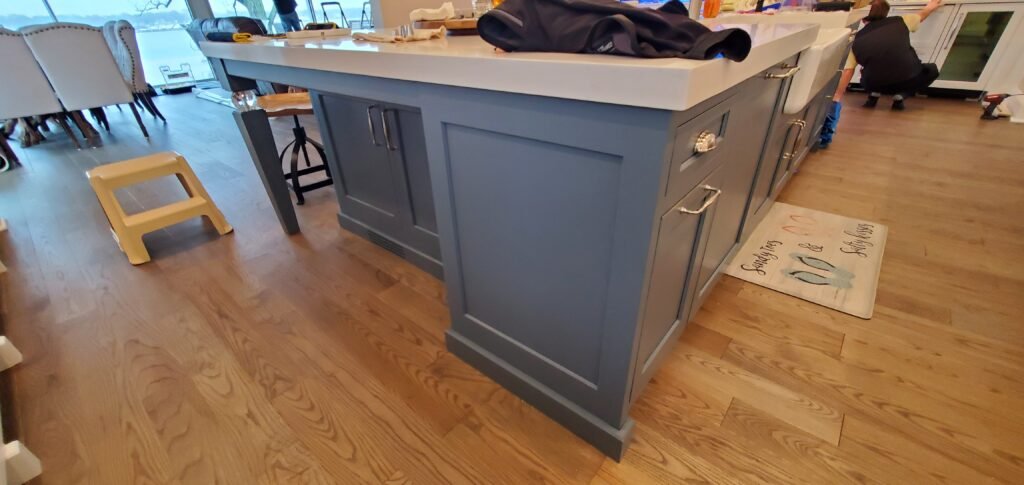
Islands are typically priced separately from the wall run because they are more complex to build and install. An island with a single-width base costs less than a large double-sided island with a prep sink, drawers on multiple sides, and a seating overhang. Island pricing is included in your overall quote after the design is developed. It is not hidden, but it is a separate line item rather than being folded into the per-linear-foot number.
How does Pennsylvania pricing compare to national averages?
Pennsylvania mid-Atlantic market pricing sits in the middle of the national range. More expensive than rural Midwest markets, less expensive than New York City or San Francisco. The Lancaster County and Chester County markets specifically are established home renovation markets with homeowners who value quality, which keeps local pricing honest without the coastal premium.
Can I reduce the cost by choosing simpler hardware or a less expensive wood?
Yes, meaningfully. Choosing paint-grade poplar over white oak can save $4,000 to $8,000 on a full kitchen. Choosing a standard shaker door over inset construction saves 15 to 25 percent on the door component. Choosing mid-range hardware over premium hardware can save $800 to $1,500 on a typical kitchen. We walk through these tradeoffs during the design consultation so you can make informed choices about where to spend and where to save.
How do I know if a quote is reasonable?
The best way to evaluate a cabinet quote is to understand exactly what it includes. Is installation included? Is hardware included? Is the price for cabinets only or cabinets plus countertops? Once you are comparing equivalent scopes, the price tells you something. A quote that is dramatically lower than others for equivalent scope is usually a signal of lower construction quality, not greater efficiency. A quote that is much higher might include services or materials that others are not including. Get a quote from us and compare it directly.
What is the cheapest way to get quality custom cabinets in Pennsylvania?
Work directly with the manufacturer rather than through a dealer. Our shop builds and installs without a middleman, which eliminates the 30 to 50 percent dealer markup that is built into showroom pricing. Visit our showroom in Honey Brook to see finished examples and discuss your project directly with the people who will build it.
Get a Real Number for Your Kitchen
The ranges in this post are as accurate as we can make them for typical Pennsylvania projects in 2026. But your kitchen is specific, and the only way to get a number you can actually plan around is a consultation with your space measured and your priorities understood.
We offer free design consultations at our Honey Brook showroom and will visit your home for larger projects across Lancaster County, Chester County, Philadelphia, York, Harrisburg, and surrounding areas. Request a free quote online or call (610) 273-2907.
You can also browse our project gallery for a sense of what different price points and material choices look like in finished kitchens, and explore our full pricing guide for room-by-room cost breakdowns beyond the kitchen.