There is a particular kind of room that stops people in their tracks. Not because it is flashy or oversized, but because every surface feels considered and every detail belongs. A floor-to-ceiling library wall with a rolling ladder is one of the few interior elements that achieves that effect consistently, regardless of the style of the home around it.
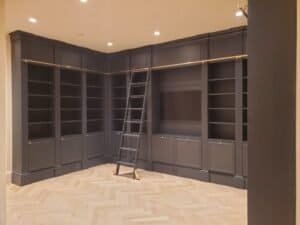
The room in the photo above is a custom home office and library we built for a Pennsylvania homeowner. Dark charcoal painted built-ins covering two full walls in an L-configuration, floor-to-ceiling open shelving with adjustable shelf positions, raised panel lower cabinet doors, fluted pilaster columns at the transitions between bays, a continuous brass ladder rail running both walls, and a matching rolling ladder with brass hardware at the floor stops.
Everything is made from solid hardwood. The finish is a hand-sprayed conversion varnish in a deep matte charcoal. The herringbone white oak floors were installed by a separate flooring contractor and the built-ins were designed and positioned to coordinate with the floor pattern rather than fight it.
If you are planning a home office renovation in Lancaster County, Chester County, or the Philadelphia area and you want something that will still look exceptional in 30 years, this post covers what goes into a project like this and how to think about your own.
Why Home Office Built-Ins Are One of the Best Investments in Your Home
The practical case for a proper home office is straightforward: a dedicated, well-organized space where you can actually work changes how productive you are. Storage that belongs to the room means a desk surface that stays clear. Shelving at the right height means reference materials within reach without a separate bookshelf taking up floor space. A room that looks serious produces serious work.
But there is a financial case that most homeowners do not think about until they are selling. A custom built-in library or home office is one of the few renovations that appraisers consistently note as a value-adding feature rather than a personal preference. In the market for distinctive homes across southeastern Pennsylvania, a room with a library wall and a rolling ladder does not sit on the market. Buyers remember it.
The design also ages extraordinarily well. Painted built-ins with traditional millwork details do not have a trend expiration date the way some kitchen renovations do. The room in the photo above could have been built in 1995 or last year, and it will look equally correct in 2045. That kind of longevity is worth paying for once rather than renovating again in ten years.
The Rolling Ladder: Functional Detail or Pure Architecture
The rolling library ladder is the detail that makes this type of room. It is functional in the literal sense, you need it to reach the upper shelves, but it also does something architecturally that no other single element can do: it tells you immediately what kind of room you are in and what the room takes seriously.
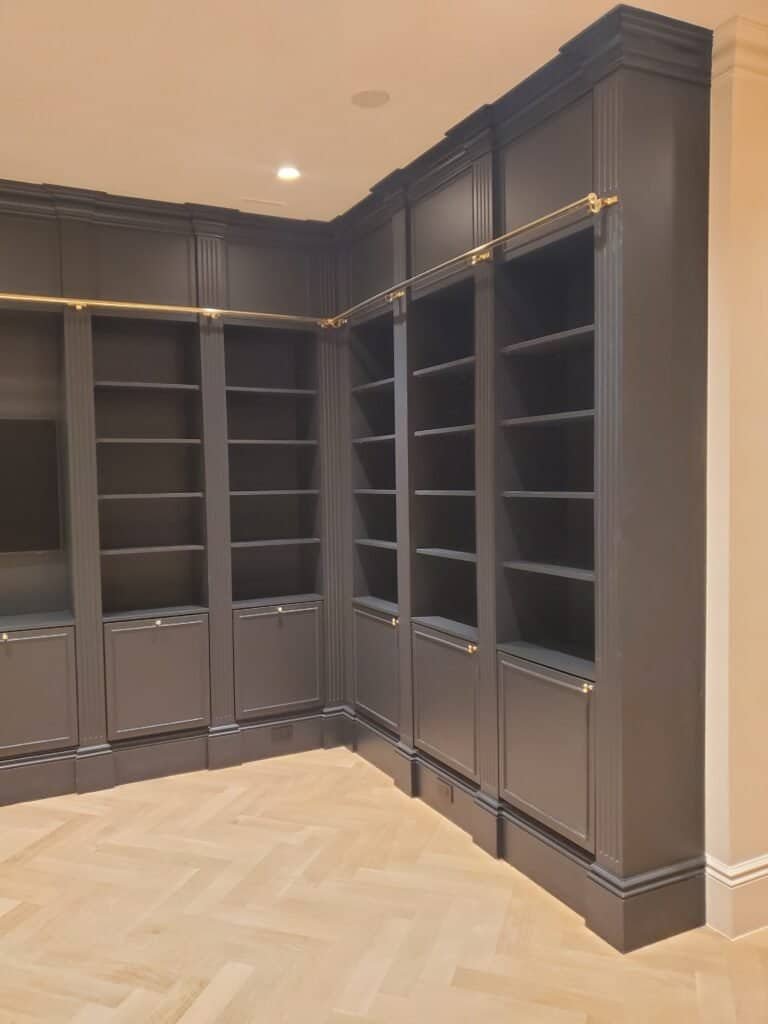
The mechanics are straightforward. A continuous brass rail is mounted at a consistent height across the full width of the built-in, in this case running around the corner to cover both walls. The ladder rolls along the rail on hardware mounted at the top, and the feet have brass-capped stops that prevent the bottom from sliding when weight is applied. The ladder itself is built from the same material and finish as the cabinets so it reads as part of the room rather than an accessory brought in from somewhere else.
A few things determine whether a rolling ladder installation works or looks awkward. The rail height needs to be consistent with the shelf height so the ladder reaches the top shelf comfortably. The ladder angle needs to be steep enough to stay against the cabinet face without the feet protruding too far into the room. And the ladder width needs to be proportional to the bay widths of the built-in. We design all of this during the drawing phase before anything is built.
The rolling ladder option is available on any of our floor-to-ceiling installations. For rooms under 9 feet it is rarely necessary. For rooms at 10 feet and above it becomes both practical and one of the most memorable features of the space. Our post on floor-to-ceiling cabinetry covers the structural and design details that make tall installations work.
The Millwork Details That Make This Room Work
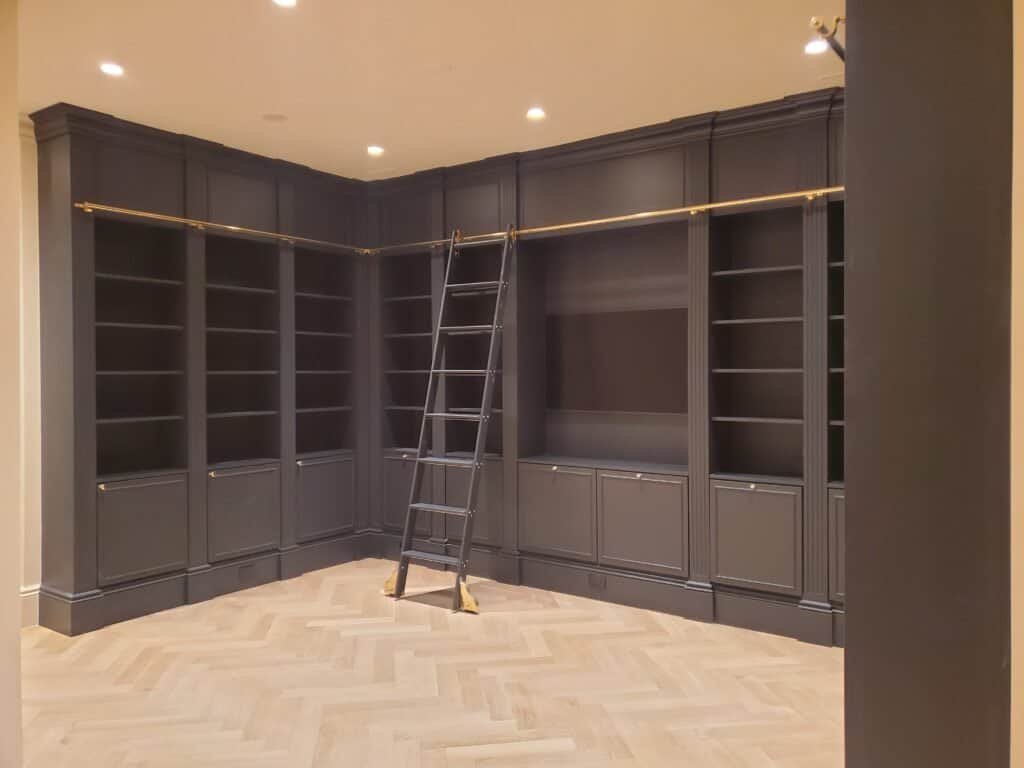
What separates a library wall from a collection of tall shelves is the architectural vocabulary: the elements that make the built-in feel like it belongs to the building rather than sitting inside it.
Fluted pilasters
The vertical columns between bays in this project are fluted pilasters, rounded columns with vertical channels that reference classical architectural orders. They serve a structural purpose, covering the joint between adjacent cabinet sections, but they also create rhythm and visual weight that makes the whole installation feel substantial. Without them, a row of tall bookcases reads as furniture. With them, it reads as architecture.
Raised panel lower cabinets
The lower cabinet doors use a traditional raised panel profile. The panel is built up from the face of the door rather than recessed into it, which creates shadow lines and dimensional depth that flat or shaker doors do not have. In a dark painted finish, raised panel doors are particularly effective because the shadow lines register clearly and give the surface texture at any time of day.
Crown molding at ceiling
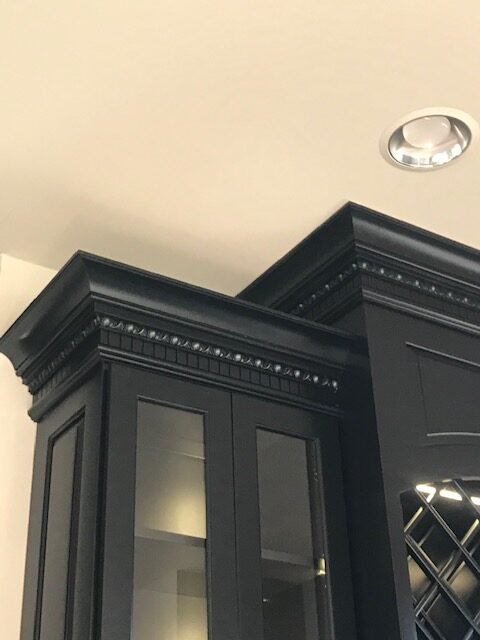
The crown molding at the top of this installation makes the transition to the ceiling feel intentional. The crown profile coordinates with the pilaster capitals at the corners and creates a complete compositional frame around the room. Getting this detail right requires scribing to the actual ceiling, which in most Pennsylvania homes is not perfectly level. For more on how we handle that, see our guide to custom crown molding and installation.
Base and plinth details
The base of the unit sits on a substantial plinth that reads as a continuous base running across both walls. This is one of the details that most distinguishes a professionally designed built-in from a DIY installation. The base creates a visual ground that anchors the whole piece and provides a surface that can be cleaned and maintained without damaging the lower cabinet finish.
Dark Painted Finishes in Home Offices: What Works and Why
Dark built-ins in a home office or library are one of the most enduring combinations in residential design. The reasons are partly psychological and partly optical.
A dark room with substantial millwork reads as serious and focused. It signals that this is a room for thinking, not a room for browsing. That may sound like an aesthetic preference, but it has a real effect on how the space functions and how people feel working in it.
Optically, a dark painted built-in recedes slightly and makes the objects on the shelves, books, objects, art, stand out with more visual presence. In a light-painted room with light built-ins, the shelves and their contents tend to blend together. In a dark room, each shelf reads as a distinct horizontal plane and the objects on it read as individual elements.
The specific color in this project is a deep charcoal with a matte finish. Matte finishes on dark colors are dramatically more forgiving of fingerprints and handling than semi-gloss or satin, which is important in a room that is used daily. The conversion varnish we use provides durability comparable to a harder sheen without the visual disadvantage.
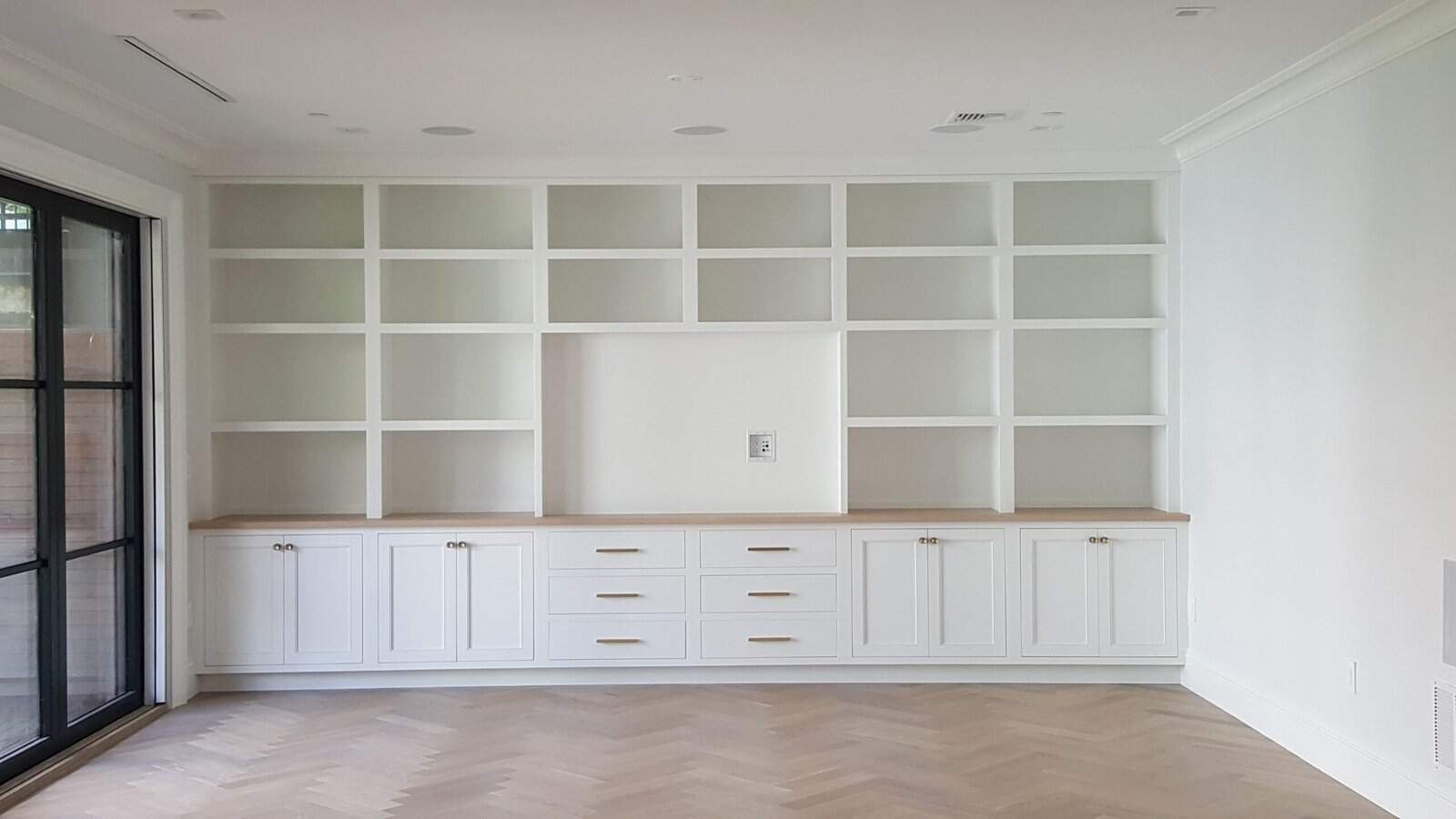
For contrast, see how a white painted finish works in a different built-in context in our Lancaster County built-in bookcase project. The two approaches produce completely different rooms from the same basic construction.
How We Design a Home Office Built-In
A home office built-in project starts with a conversation about how the room will actually be used. This sounds obvious but it changes the design in meaningful ways.
A lawyer’s office needs different storage organization than a writer’s. A financial advisor who takes client meetings at home needs the room to project authority in a way that a creative director working alone does not. Someone who uses two monitors needs a different desk configuration than someone who works from a laptop. We ask these questions at the start because they determine shelf spacing, drawer organization, desk height, and whether the TV position shown in this project matters or not.
From there we produce detailed design drawings and a 3D rendering showing the room as it will look when complete. You approve the design before anything is built. Changes at the drawing stage cost nothing. Changes after production starts are expensive, so we take the drawing phase seriously.
Production takes place in our 20,000 sq ft Honey Brook facility. The built-in is constructed in sections, finished in our spray department, and installed in typically one to two days depending on complexity. You can read more about the full timeline on our how we work page.
Home Office Built-Ins Across Pennsylvania
We build and install home office cabinetry throughout Lancaster County, Chester County, Berks County, York, Dauphin County, and the Philadelphia metropolitan area. Our client base for home office projects skews toward homeowners in established neighborhoods with larger homes, and toward professionals who work from home and treat their office as a genuine workspace rather than a spare bedroom with a desk in it.
Communities we work in regularly for this type of project include Malvern, Wayne, Paoli, Devon, Berwyn, West Chester, Kennett Square, Downingtown, Exton, and throughout Lancaster County. For Philadelphia clients, we serve the Main Line neighborhoods and the city proper for larger projects.
For design inspiration from libraries and home offices nationally, Architectural Digest has assembled a comprehensive gallery of home library designs that covers the full range from intimate reading rooms to grand two-story libraries.
Questions About Home Office Built-Ins
How much does a home office built-in with a rolling ladder cost?
A full L-configuration library wall like the one shown, with a rolling ladder, brass rail, raised panel lower cabinets, and floor-to-ceiling shelving on two walls, typically ranges from $18,000 to $35,000 installed depending on the room size, finish complexity, and millwork details. A single-wall installation without the ladder starts considerably lower. Request a quote with your room dimensions for a specific estimate.
Can you add a rolling ladder to an existing built-in?
Sometimes yes, sometimes no. The rail needs to be fastened to cabinet structure at a consistent height, and the ladder needs clearance to roll without hitting lighting fixtures, vent grilles, or other ceiling elements. If you have an existing built-in you want to add a ladder to, send us photos and dimensions and we can assess whether it is feasible and what it would involve.
What room height do you need for a rolling ladder to make sense?
Practically speaking, a rolling ladder makes sense at ceiling heights of 10 feet or more. At 9 feet, the ladder is useful but short enough that most people simply reach for the top shelf. At 10 and above, the ladder becomes both practical and a genuine design feature. At 12 feet and above, it is essentially required for the upper shelves to be accessible.
How do you handle the corner in an L-shaped installation?
The corner treatment is one of the defining details of an L-configuration. In this project we used a full-height pilaster at the interior corner that covers the joint between the two wall runs and integrates visually with the pilasters throughout the rest of the piece. The ladder rail turns the corner on a purpose-made brass corner fitting. Both the joint treatment and the corner hardware are designed during the drawing phase and built into the unit.
Do you serve Philadelphia and the Main Line for home office projects?
Yes. We regularly install in Philadelphia proper, along the Main Line, and throughout Chester County and Montgomery County for home office and library projects. Call us at (610) 273-2907 or request a quote online.
Build Your Home Office
If you have a room that deserves this kind of treatment, the first step is seeing what the design could look like. We produce detailed drawings and 3D renderings before any commitment to production, so you can see the finished room before it exists.
Free consultations at our Honey Brook showroom or at your home for larger projects. Request a free quote online or call (610) 273-2907.
Browse more projects in our gallery or read about the people who build every piece on our about page.
Located in the area? See how we build custom cabinets in Lancaster, PA for homeowners across the county.
Library walls are our specialty — explore all the custom built-in bookcases in Pennsylvania we build.