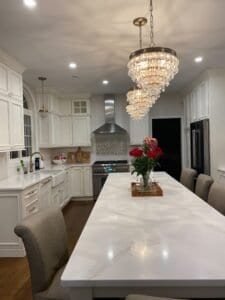
Why true luxury isn’t about the color—it’s about the joinery, the millwork profiles, and the chemistry of the finish.
In the world of interior design, the “White Kitchen” is ubiquitous. Scroll through Instagram or Houzz, and you will see thousands of them. But there is a massive difference between a white kitchen bought from a big-box store and a custom architectural asset engineered in a dedicated manufacturing facility.
At Choice Custom Cabinetry & Design, we believe that “White” is the most unforgiving color in woodworking. It hides nothing. Every shadow, every joint, and every texture is visible. To make a white kitchen feel warm, luxurious, and “finished,” you need more than paint—you need engineering.
In this deep-dive case study, we are taking you behind the scenes of our recent project. We will explore the physics of the cabinet box, the geometry of the crown molding, and the material science that ensures this kitchen will look exactly the same in 20 years as it does today.
The Design Philosophy – Creating “Verticality”
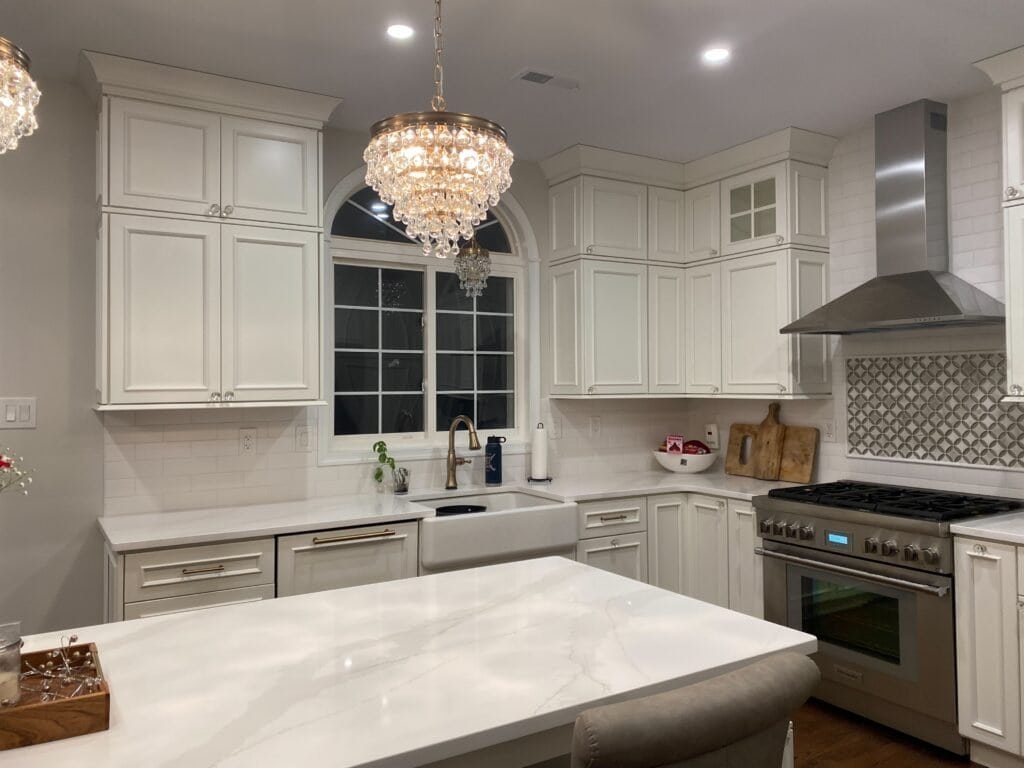
When you look at this project, your eye is immediately drawn upward. In many Pennsylvania homes, ceilings are standard height (8 or 9 feet). The homeowner’s challenge was simple: “Make it feel grand.”
The Illusion of Height
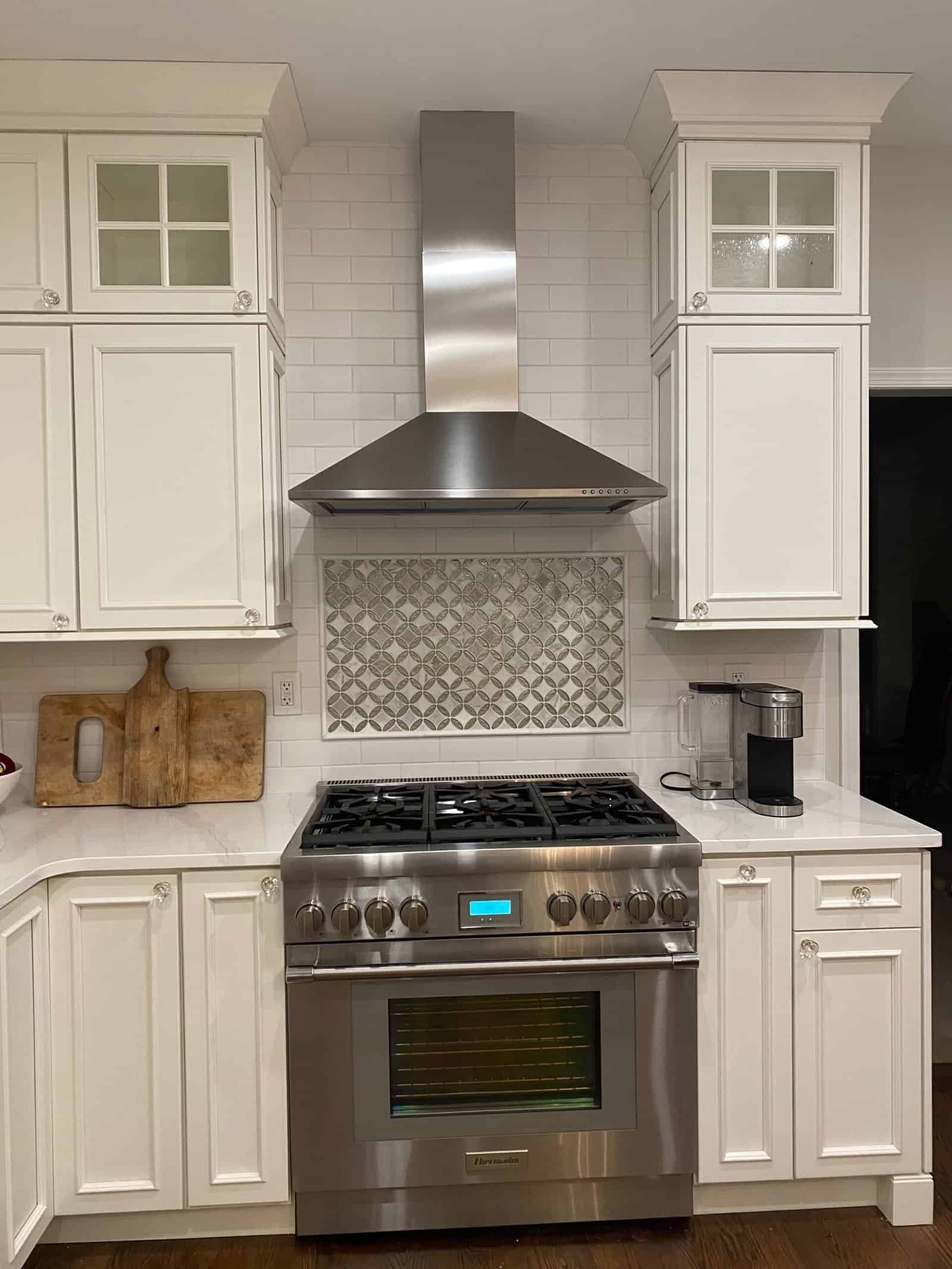
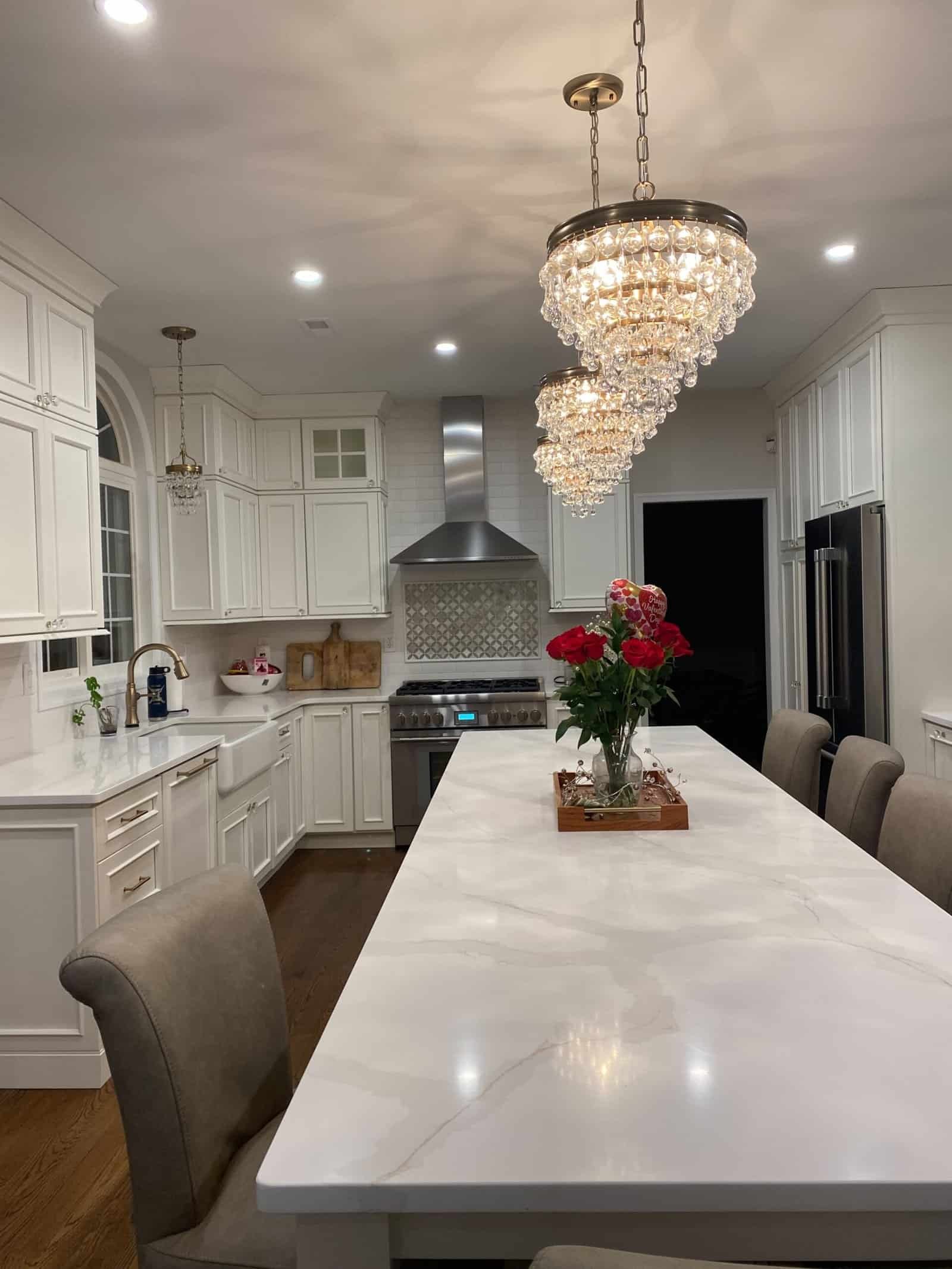
We achieved this through a concept called Vertical Stacking. Instead of stopping the cabinets 12 inches below the ceiling (a common cost-saving measure in semi-custom cabinetry), we extended the millwork to the soffit.
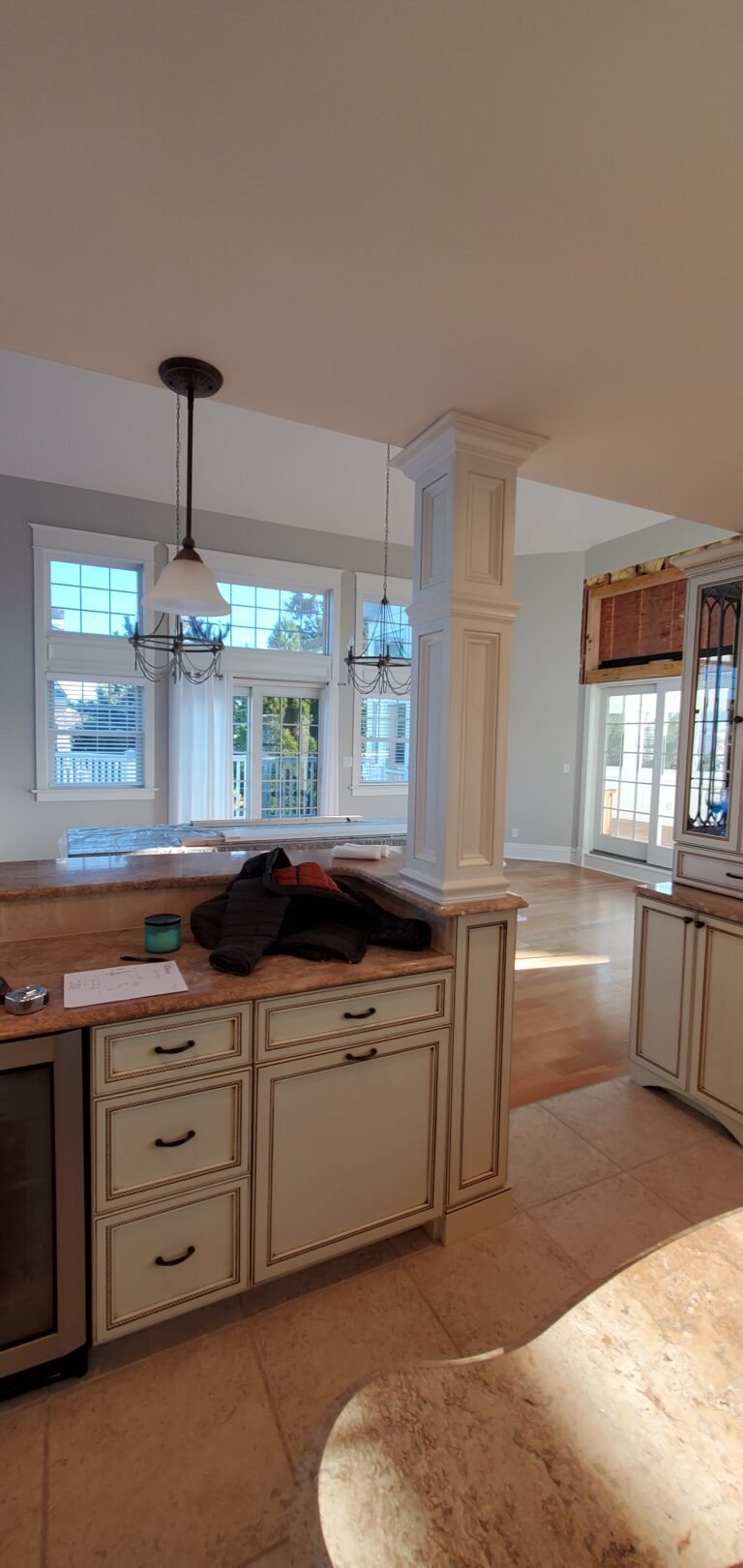
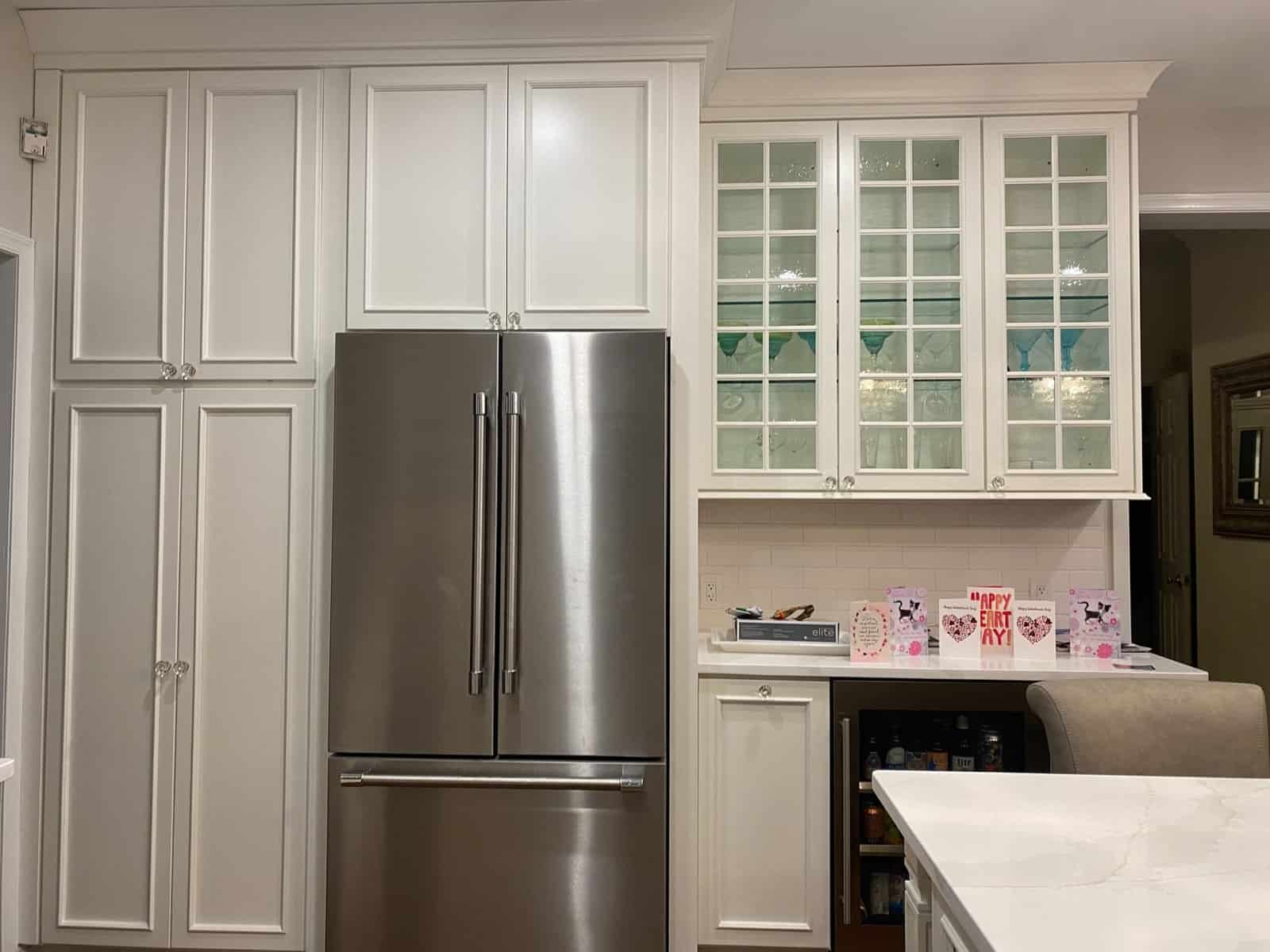
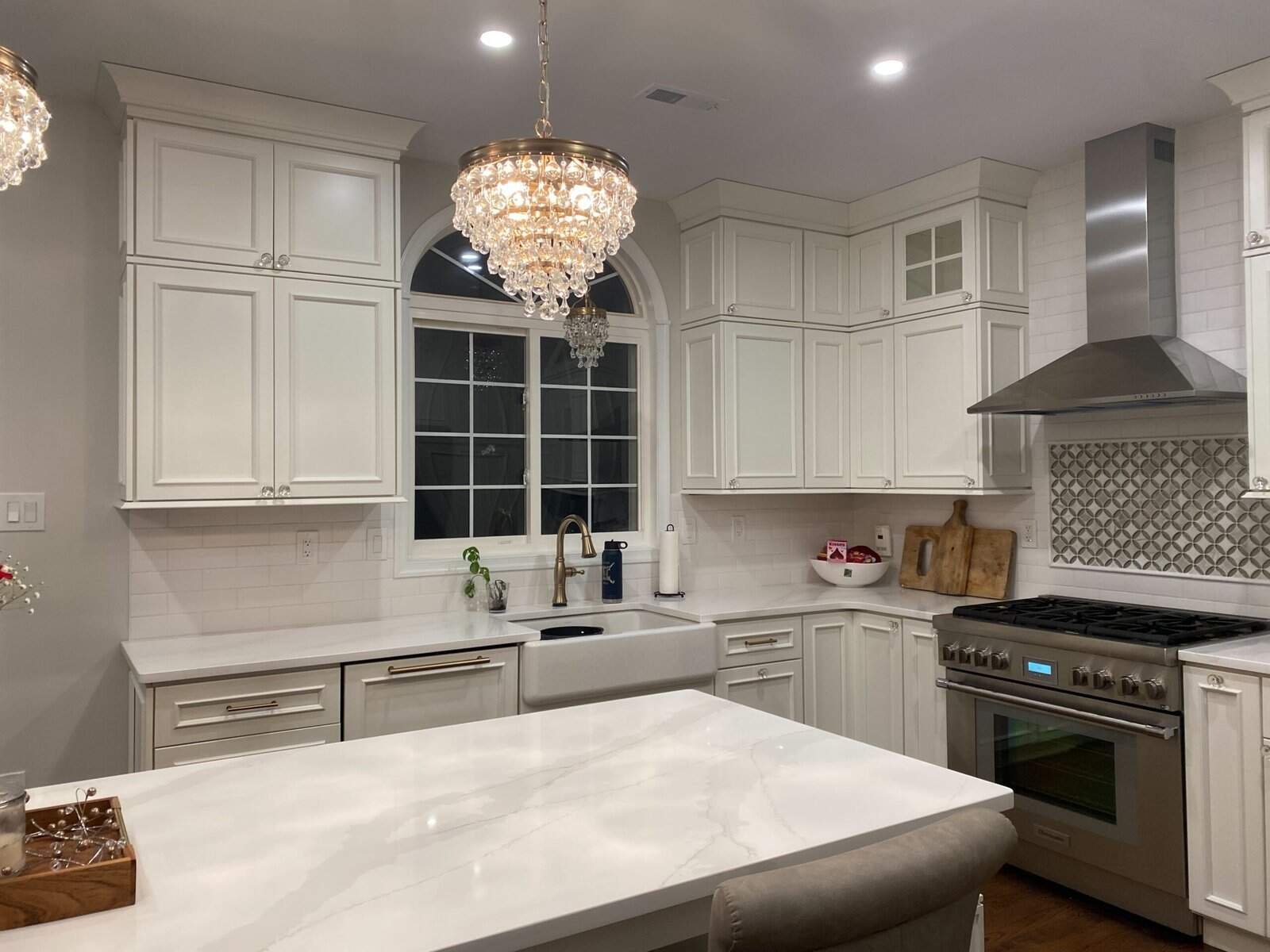
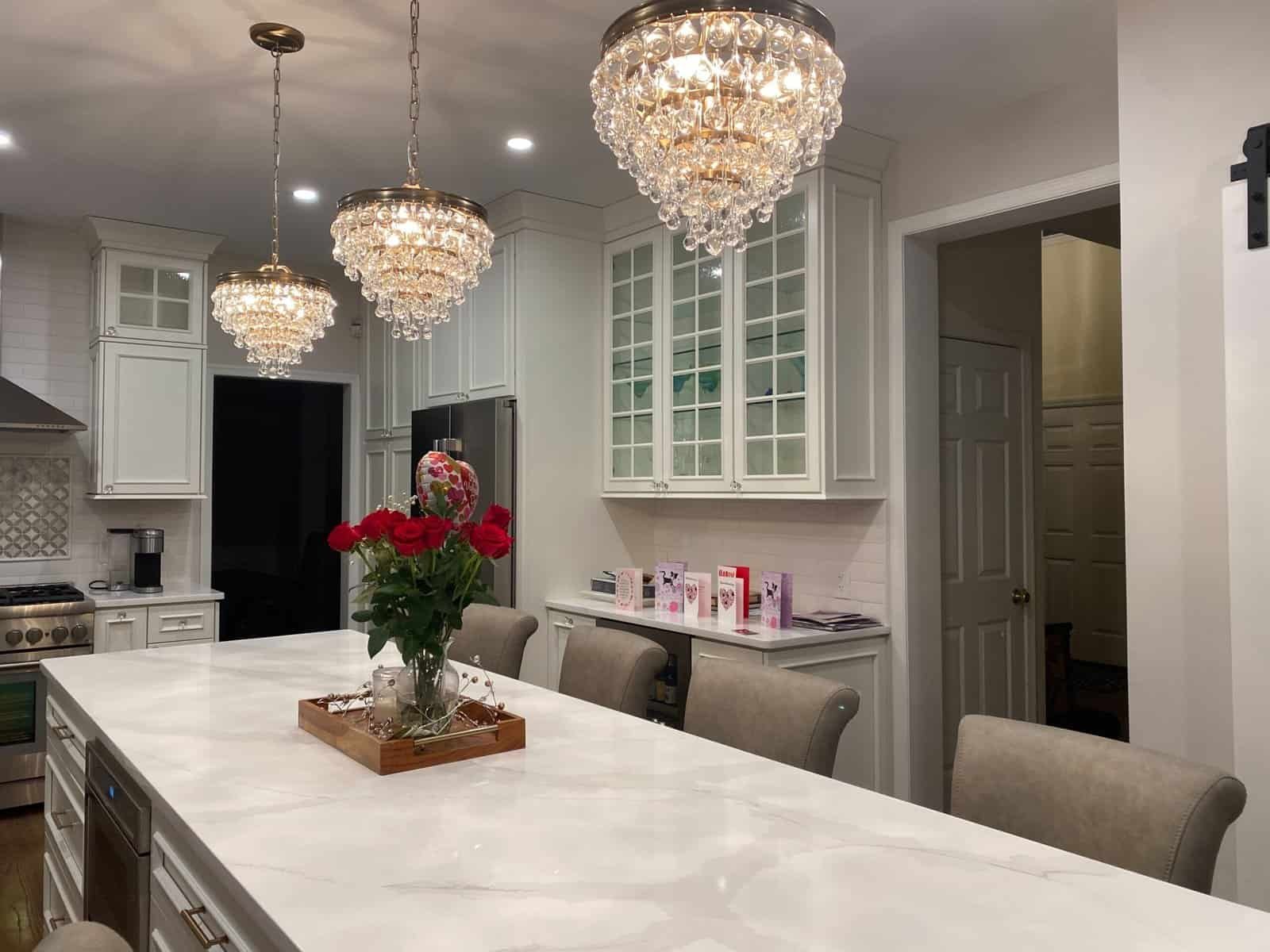
- The Transom Cabinets: Notice the upper row of glass-front cabinets. These “transoms” serve as display cases for the client’s decor, illuminated from within. They break up the solid mass of wood and reflect the light from the crystal chandeliers.
- Symmetry and Balance: The design is anchored by the farmhouse sink and the window. We centered the island pendants perfectly with the window mullions. This is not accidental; it is the result of precise CAD drafting before production begins.
Lighting as a Material
In a white kitchen, light is as important as wood. We used the reflective properties of the Post-Catalyzed Conversion Varnish (more on that in Chapter 4) to bounce light from the chandeliers around the room. The result is a space that feels airy and expansive, not sterile.
The Sink Cradle
Look at the farmhouse sink in the photo. Fireclay sinks are incredibly heavy—often exceeding 80 lbs when empty, and 150 lbs when filled with water and dishes. We don’t just set these on a standard shelf. We engineer a reinforced lumber “cradle” inside the sink base cabinet. This transfers the load directly to the floor, preventing the cabinet face frame from bowing over time.
Architectural Millwork – The Crown Jewel
This is where true custom manufacturing separates itself from “assemblers.” A standard kitchen installer buys 8-foot strips of molding from a lumber yard. We mill our own profiles to control the shadow lines.
Anatomy of a Build-Up
The crown molding you see in this project is not a single piece of wood. It is a Multi-Piece Assembly.
- The Frieze Board: A flat vertical board that extends the cabinet height.
- The Bottom Detail: A small molding that hides the seam between the cabinet and the frieze.
- The Cap: The engineered crown profile itself.
The Engineering of Shadow
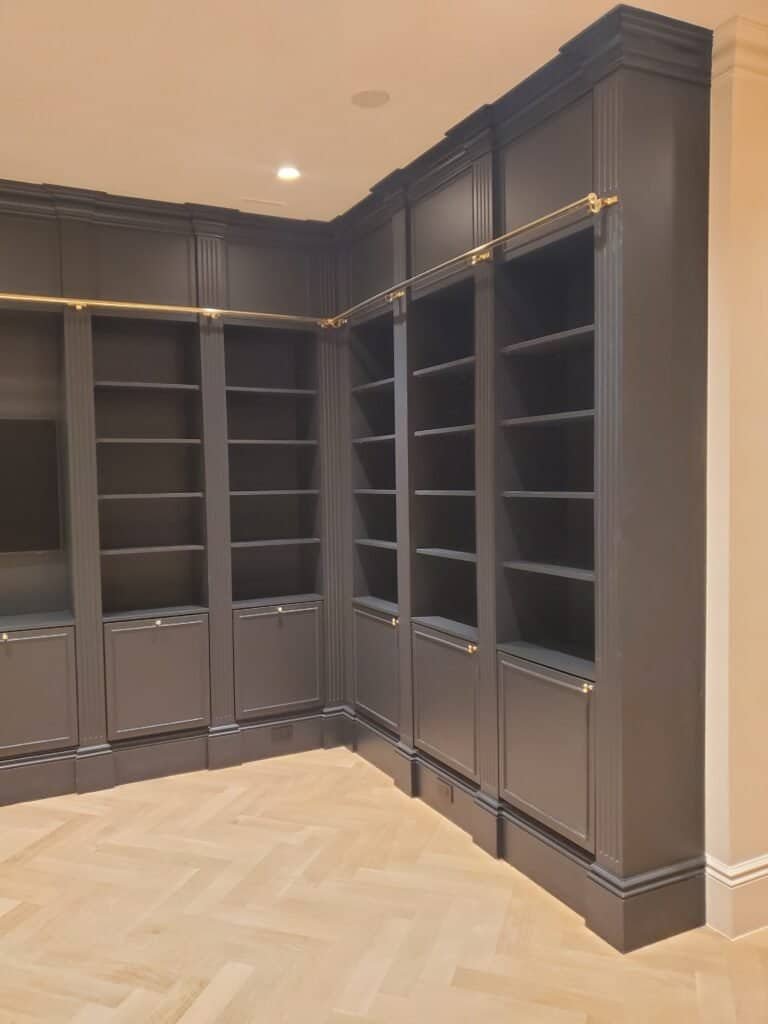
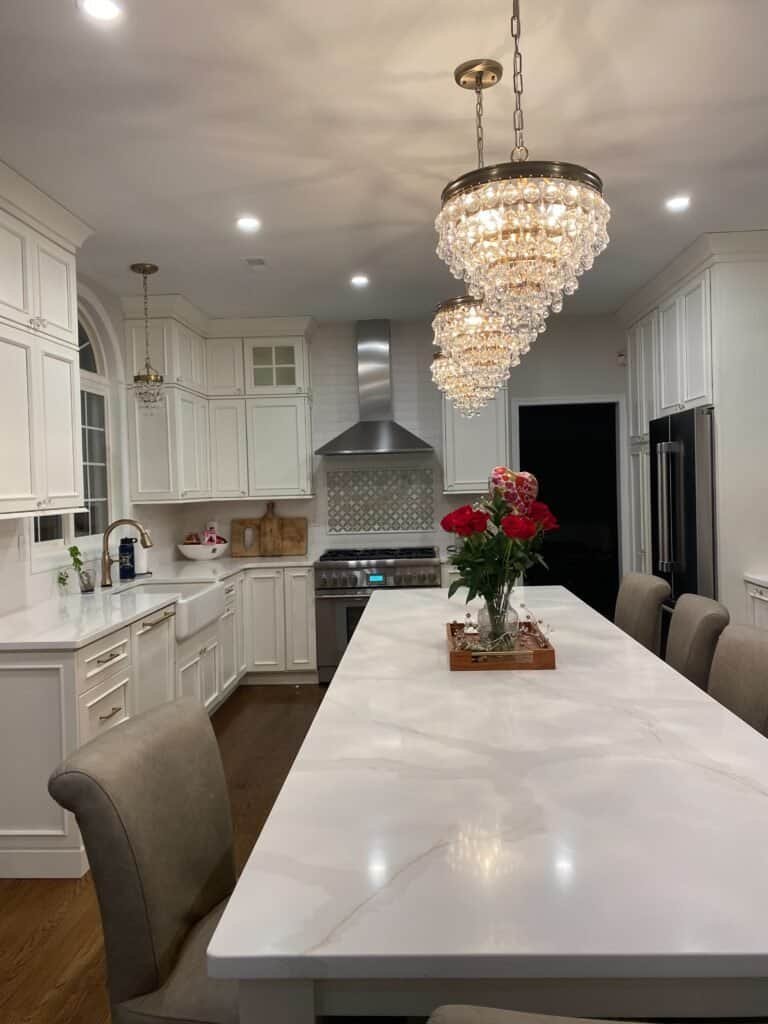
Why do we mill our own profiles? Because stock profiles are often “flat.” They don’t cast shadows. We utilize CAD technology to design profiles with deep relief.
- The 134 Crown: Take a look at our schematic for the 134 Crown. Notice the deep cove curve. This curve is designed to trap shadow. Even in a brightly lit white kitchen, that shadow line defines the ceiling, giving the room architectural weight.
- The 121 Crown: In other areas, we might use the 121 Crown, which is engineered for massive projection (sticking out further onto the ceiling). This is useful for clearing window casings or uneven soffits.
When we draft your project, we calculate exactly how these profiles will intersect with your vents and corners.
Material Science – Paint Grade vs. Stain Grade
One of the most common questions we get is: “What wood is under the white paint?”
The Myth of MDF
There is a trend in the industry to use MDF (Medium Density Fiberboard) for painted doors because it is stable. However, MDF is heavy, cannot hold screws well, and is susceptible to water damage at the edges.
The Choice Specification: Paint Grade Hardwoods
For this project, we utilized materials from our verified stock list.
- Paint Grade Maple: We often specify Paint Grade Maple or Poplar for the face frames and door stiles.
- Why Maple? It is a closed-grain hardwood. Unlike Oak (which has deep open pores that show through paint) or Pine (which is soft and dents easily), Maple provides a glass-smooth surface that is incredibly hard. It resists the “dents and dings” of vacuum cleaners and children’s toys.
The Finish Chemistry
You cannot achieve this look with a paintbrush. Site-painted cabinets (painted by a contractor in your house) will always have brush marks, dust inclusions, and a weak bond. We use a Post-Catalyzed Conversion Varnish.
- The Process: In our spray booth, the varnish is mixed with a catalyst (hardener) just before application.
- The Result: As it cures, it cross-links at a molecular level. It becomes a plastic-like armor that is chemically bonded to the wood fibers. It is resistant to vinegar, lemon juice, oil, and red wine. You can wipe this white kitchen down with standard cleaners for decades without wearing through the paint.
Inset vs. Overlay – A Pennsylvania Tradition
In this specific project, you are seeing a blend of traditional aesthetics with modern functionality.
Understanding the Difference
- Inset Cabinetry: The door fits inside the face frame. This is the historic standard seen in 18th-century Pennsylvania farmhouses. It requires extreme precision—gaps must be exactly 3/32″ all around.
- Full Overlay: The door sits on top of the frame, covering it completely.
For this client, we utilized an Overlay construction to maximize interior storage space and provide a cleaner, transitional look, while using applied moldings on the doors to mimic the depth of traditional joinery.
Artistic Hierarchy – Adding Sculpture to Function
While this kitchen is clean and linear, we have the capability to introduce organic forms. In more ornate sections of the home (like a range hood or a library mantel), we integrate Ornamental Millwork.
Hand-Carved Details
We don’t rely solely on CNC machines. As seen in our portfolio, we utilize hand-carved elements:
- Acanthus Corbels: Used to support range hoods or islands.
- Scroll Onlays: Applied to frieze boards to add texture. These details act as “jewelry” for the cabinetry. In a white kitchen, a carved corbel creates a complex play of light and shadow that a flat board simply cannot match.
The Value Proposition – ROI of Custom
Why invest in custom manufacturing instead of a semi-custom brand? Real estate agents in the Main Line and Chester County agree: The kitchen sells the home.
- Longevity as an Asset: A kitchen built with plywood and Conversion Varnish is a 30-year asset. A particle board kitchen is a 10-year liability.
- Space Maximization: We build to 1/16″ tolerances. We don’t use 3-inch filler strips. That means you get 15-20% more usable drawer space in the same footprint.
- The “Feel”: When a buyer opens a drawer, they feel the weight of the solid dovetail maple box and the smooth resistance of the soft-close glide. That tactile experience signals “Quality” instantly.
Engineering Your Dream
This white kitchen is successful not just because it is beautiful, but because it is built on a foundation of engineering and material science.
From the selection of Rift Cut or Quarter Sawn White Oak for stained accents to the drafting of the 125 Crown Profile, we control every variable.
Choice Custom Cabinetry & Design is not just a cabinet shop; we are your partners in architectural manufacturing.
Ready to start your conversation?
Stop looking at generic catalogs. Come visit our showroom in Honey Brook, PA, and see the difference between “furniture” and “cabinetry.”